
Application of VoIP and SIP in Industrial Routers
Table of Contents
Preface: Why Do Industrial Scenarios Need Voice Communication?
Basic Concepts of VoIP and SIP
Typical Application Scenarios of VoIP/SIP on Industrial Routers
4.1 Industrial Site Voice Intercom
4.2 Unattended Site Remote Calling
4.3 Voice Alarm and Linkage Systems
4.4 Industrial Private Network/Industry Private Network Voice Communication
Advantages of Combining VoIP/SIP with 4G/5G Industrial Routers
Considerations When Deploying VoIP/SIP Industrial Applications
Preface: Why Do Industrial Scenarios Need Voice Communication?
In the wave of digital transformation, people often focus their attention on areas such as data collection, automation control, and intelligent analysis, yet easily overlook a fundamental and important need—voice communication.
In industrial settings, the importance of voice communication is self-evident. Imagine these scenarios: a hydropower station in a remote mountainous area needs to communicate with the dispatch center in real-time about flood conditions; inspection personnel at a chemical plant need to immediately call the emergency command center when abnormalities are discovered; workers in mine shafts need to maintain contact with the surface at all times; and dispatchers at port terminals need to coordinate with various operation points.
Limitations of Traditional Industrial Voice Communication:
Issue | Impact |
High infrastructure costs | Wiring costs in remote areas can reach tens to hundreds of thousands of dollars |
Poor scalability | Adding nodes requires rewiring with long construction periods |
Single functionality | Difficult to integrate with modern industrial management systems |
Difficult maintenance | High costs for troubleshooting and repairing line faults |
The combination of IP network-based VoIP technology with industrial routers brings a completely new solution for industrial voice communication. By reusing existing industrial network infrastructure, VoIP not only significantly reduces deployment costs but also provides stronger flexibility, scalability, and intelligent capabilities.
Basic Concepts of VoIP and SIP
2.1 What is VoIP?
VoIP, which stands for Voice over Internet Protocol, also known as IP telephony, is a technology that transmits voice communications over Internet Protocol (IP) networks.
Three Working Principle Steps:
Voice Acquisition and Encoding - Analog voice → Digital signal → Compressed encoding
Data Encapsulation and Transmission - Voice data → IP packets → Network transmission
Reception and Decoding - Receive packets → Decode → Analog signal → Playback
Core Advantages Comparison:
Comparison Item | Traditional Telephone | VoIP |
Infrastructure costs | Requires separate telephone line installation | Reuses existing IP network |
Long-distance call costs | Billed by duration/distance | Almost zero |
Deployment cycle | Requires construction and wiring, long cycle | Plug and play, rapid deployment |
Scalability | Limited by wiring | Flexible expansion, no physical limitations |
Advanced features | Limited functionality | Call forwarding, voicemail, conferencing, etc. |
System integration | Difficult to integrate | Easy to integrate with business systems |

2.2 What is SIP?
SIP, which stands for Session Initiation Protocol, is the most commonly used signaling protocol in VoIP systems, responsible for establishing, managing, and terminating voice sessions.
SIP Core Functions:
User Location - Determines the current location (IP address and port) of the called party
Capability Negotiation - Negotiates supported encoding formats, transmission protocols, etc.
Session Establishment - Initiates call requests and establishes call connections
Session Management - Handles call hold, transfer, conferencing, and other operations
Session Termination - Normally or abnormally ends calls
Typical SIP Call Flow:
Caller                      Called Party
|------- INVITE request ------>|
|<------ 180 Ringing ----------| (Ringing)
|<------ 200 OK ---------------| (Answer)
|------- ACK confirmation ---->|
|<====== Voice Call (RTP) ====>|
|------- BYE request --------->| (Hang up)
|<------ 200 OK ---------------|
Why Choose SIP?
Open Standards - Based on IETF open standards, not vendor-locked
Simple and Flexible - Text-based protocol, easy to understand and implement
Good Scalability - Can easily add new features and services
Strong Interoperability - SIP devices from different vendors can interoperate

Role of Industrial Routers in VoIP/SIP Systems
Industrial routers play multiple critical roles in VoIP/SIP systems:
Role | Function Description | Application Value |
Network Access Gateway | Provides wired/wireless/multi-network convergence access | Provides reliable network connectivity for VoIP terminals |
VoIP Gateway | FXS/FXO interfaces, connecting traditional telephone equipment | Enables interoperability between traditional and IP telephony |
SIP Proxy Server | Local call processing, user authentication, call routing | Reduces latency, lightens central server load |
QoS Controller | Traffic classification, priority scheduling, bandwidth guarantee | Ensures voice call quality |
Security Protection Device | Firewall, VPN encryption, access control | Protects VoIP system security |
Edge Computing Node | Local intelligent processing, fault self-healing | Improves response speed and system reliability |
Core Value:
Industrial routers are not merely network connection devices, but the core support of the entire industrial voice communication system, integrating communication, computing, and security.

Typical Application Scenarios of VoIP/SIP on Industrial Routers
4.1 Industrial Site Voice Intercom
Application Background: Large factories, workshops, warehouses, and other industrial sites have vast work areas with high ambient noise and require frequent communication and coordination.
Solution:
Deploy industrial-grade IP intercom terminals at key locations throughout the facility
Connect to industrial routers via industrial Ethernet or WiFi
Support one-touch calling, group broadcasting, emergency alarms
Typical Case: A certain automobile manufacturing plant deployed 50 IP intercom points across four major workshops. Workshop supervisors can communicate with any intercom point via a dispatch console or broadcast to the entire workshop. The system is integrated with MES, automatically triggering voice alarms when production line anomalies occur.
Application Value:
☑ Covers the entire facility, eliminating communication dead zones
☑ No call charges, reducing operating costs
☑ Supports one-to-one, one-to-many, and many-to-many calls
☑ Integrates with production systems for intelligent management
4.2 Unattended Site Remote Calling
Application Background: In industries such as power, water conservancy, environmental protection, and oil and gas, a large number of monitoring stations are distributed in remote areas, unmanned but requiring contact with central dispatch.
Solution:
Equip each site with 4G/5G industrial routers integrated with VoIP functionality
Establish VPN tunnels to headquarters SIP server via mobile network
Deploy IP phones or intercom terminals at sites
Support bidirectional calling
Typical Case: A certain water utility company manages 120 mountain water quality monitoring stations. By equipping each station with a 4G industrial router and IP phone, inspection personnel can directly call the dispatch center to report situations. The system saves tens of thousands of dollars in call charges monthly.
Application Value:
☑ No need to install telephone lines, significantly reducing costs
☑ Utilizes mobile network coverage in remote areas
☑ Ensures communication security through VPN
☑ Supports remote configuration and management
4.3 Voice Alarm and Linkage Systems
Application Background: In industrial production, equipment failures, environmental anomalies, and safety accidents need to be promptly notified to relevant personnel. Traditional SMS and email are easily overlooked.
Solution:
Integrate VoIP system with SCADA, DCS, and other monitoring systems
Monitoring system triggers SIP calls via API when detecting anomalies
Broadcast alarm content via TTS (text-to-speech)
Support alarm escalation mechanism, automatically calling superiors if no response
Typical Case: A certain chemical plant integrated its DCS system with VoIP. When reactor temperature exceeds threshold, it automatically calls the on-duty engineer to broadcast the alarm. If no response within 30 seconds, it automatically calls the workshop supervisor and safety manager. Average alarm response time was reduced from 15 minutes to 2 minutes.
Application Value:
☑ More timely and intuitive alarms
☑ Supports automatic escalation and multi-level notification
☑ Seamless integration with existing systems
☑ Complete call records facilitate accident investigation

4.4 Industrial Private Network/Industry Private Network Voice Communication
Application Background: Special industries such as public security, emergency management, military, and railways need to establish independent dedicated communication networks for security and confidentiality considerations.
Solution:
Deploy independent SIP servers and media servers
Establish physically isolated networks via dedicated fiber, microwave, or satellite
Sites access private network through industrial routers
Implement strict security policies
Typical Case: A certain city emergency management bureau built an emergency communication private network covering the entire city. Through fiber ring network connecting city emergency command center, district emergency offices, fire stations, hospitals, and other nodes, over 200 voice terminals were deployed. The private network is completely independent of public networks and can operate normally even if public networks are interrupted.
Application Value:
☑ Secure and controllable, meets confidentiality requirements
☑ Independent operation, unaffected by public network failures
☑ Guaranteed service quality
☑ Supports customized function development
Key Technical Support for VoIP/SIP by Industrial Routers
Protocol and Codec Support
Mainstream Voice Codec Comparison:
Codec | Audio Quality | Bandwidth | CPU Load | Use Case |
G.711 | Best (telephone quality) | 64 kbps | Lowest | LAN, sufficient bandwidth environment |
G.729 | Good | 8 kbps | Medium | WAN, 4G/5G, satellite links |
G.722 | HD (wideband) | 64 kbps | Low | HD voice communication |
iLBC | Medium | 13-15 kbps | Medium | Unstable network, packet loss resistance |
Opus | Excellent (variable) | 6-510 kbps | Medium | Modern VoIP, adapts to various networks |
Protocol Stack Support:
SIP core protocol (RFC 3261) and extensions
SDP session description protocol (RFC 4566)
RTP/RTCP real-time transport protocol (RFC 3550)
Support for UDP, TCP, TLS, and other transport protocols
QoS Quality Assurance Mechanism
QoS Technology Stack:
┌─────────────────────────────────────┐
│ Traffic classification and marking  │
│ (DSCP/port identification)          │
├─────────────────────────────────────┤
│ Priority queue scheduling           │
│ (SP/WFQ/LLQ)                        │
├─────────────────────────────────────┤
│ Bandwidth management                │
│ (reservation/limiting/congestion    │
│  control)                           │
├─────────────────────────────────────┤
│ Jitter buffering                    │
│ (fixed/adaptive)                    │
└─────────────────────────────────────┘
Key Metric Requirements:
Metric | Requirement | Description |
Latency | <150ms | Almost imperceptible to human ear |
Jitter | <30ms | Requires jitter buffering to smooth |
Packet loss rate | <1% | Preferably 0 |
Bandwidth | Depends on codec | G.711 needs 90kbps, G.729 needs 30kbps |
NAT Traversal Technology
NAT Traversal Technology Comparison:
Technology | Working Principle | Advantages | Disadvantages | Applicable NAT Types |
STUN | Discover public address | Simple, no relay needed | Ineffective for symmetric NAT | Full/Restricted cone NAT |
TURN | Server relay | Works for all NAT types | Increases latency and cost | All types |
ICE | Integrates multiple methods | Auto-selects best path | Complex implementation | All types |
SIP ALG | Router corrects address | Transparent to application | Variable quality | Depends on implementation |
Security Mechanisms
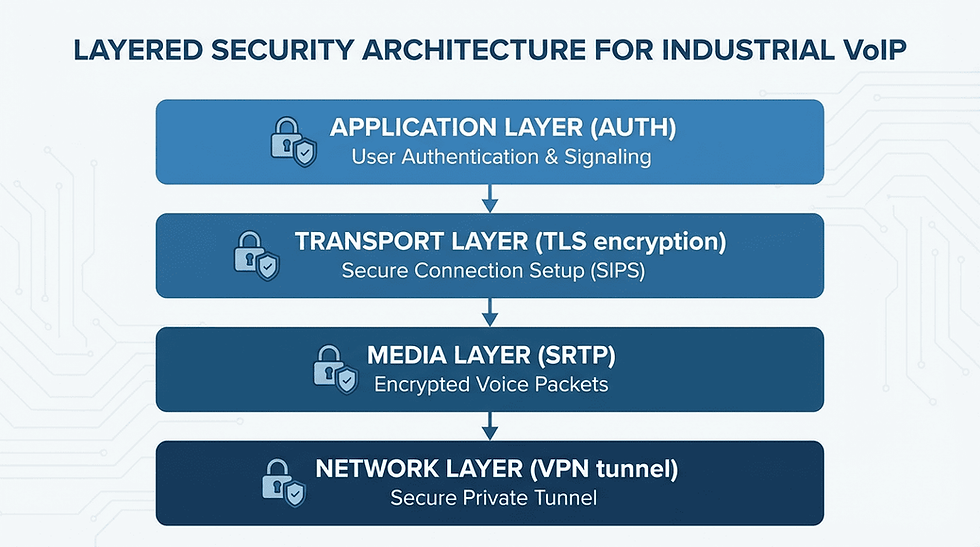
Multi-Layer Security Protection:
Security Layer | Technical Measures | Protection Target |
Application Layer | SIP digest authentication, strong passwords | Account theft |
Transport Layer | TLS-encrypted SIP signaling | Signaling eavesdropping, tampering |
Media Layer | SRTP-encrypted voice streams | Call content eavesdropping |
Network Layer | IPsec VPN tunnel | Entire communication link |
Access Layer | IP whitelist, firewall | Unauthorized access |
Advantages of Combining VoIP/SIP with 4G/5G Industrial Routers
Core Advantages Overview
Advantage | Specific Performance | Application Value |
Wide Area Coverage | 4G/5G network covers remote areas | No wiring required, rapid deployment |
High Bandwidth, Low Latency | 5G latency <50ms, supports HD voice | Experience close to wired networks |
Dedicated Private Network | Industry private network/network slicing | QoS guarantee, security isolation |
Dual Network Convergence | Wired + wireless dual backup | Improves system reliability |
Flexible Billing | IoT packages, data sharing | Significantly reduces communication costs |
4G/5G Network Performance Comparison
Metric | 4G LTE | 5G NR | Wired Network |
Downlink speed | 100-150 Mbps | 500-1000+ Mbps | 100-1000 Mbps |
Uplink speed | 50-75 Mbps | 100-500 Mbps | 100-1000 Mbps |
End-to-end latency | 50-100 ms | 30-50 ms | 10-30 ms |
Coverage range | Nationwide wide area coverage | Urban and key areas | Wired connection areas |
Mobility | Fully supported | Fully supported | Not supported |
Cost-Benefit Analysis
VoIP System Investment Return for a Mining Company with 50 Mine Shafts:
Item | Traditional Telephone | 4G VoIP | Savings |
Initial wiring cost | $1.5M | $0 | $1.5M |
Equipment cost | $0.8M | $1.0M | -$0.2M |
Monthly call charges | $250K | $25K (data fees) | $225K |
Annual operating cost | $3M | $0.3M | $2.7M |
Investment payback period | - | Approximately 6 months | - |
Considerations When Deploying VoIP/SIP Industrial Applications
Pre-Deployment Checklist
Category | Checklist Item | Key Points |
Network Planning | Bandwidth assessment | Each G.711 call needs 90kbps, G.729 needs 30kbps, reserve 1.5-2x margin |
IP address planning | Allocate independent VLAN and address segments for VoIP devices | |
Network topology design | Consider redundancy and scalability | |
Device Selection | Industrial-grade standards | Operating temperature -40°C~75°C, protection rating IP30+ |
Performance parameters | CPU, memory, SIP concurrency meets requirements | |
Interface types | FXS/FXO quantity, Ethernet port speed | |
System Integration | SIP server selection | Open source (Asterisk) or commercial (Cisco/3CX) |
Compatibility testing | Interoperability, codec, NAT traversal testing | |
API integration | Interface with SCADA, MES, and other systems | |
Security Strategy | Encrypted transmission | TLS encrypts signaling, SRTP encrypts media streams |
Access control | IP whitelist, strong password policy | |
VPN tunnel | Use IPsec/SSL VPN for cross-public network communication | |
Operations Monitoring | Monitoring system | Real-time monitoring of latency, jitter, packet loss, MOS score |
Log management | Centralized logging, regular analysis | |
Backup strategy | Regular configuration backup, rapid recovery |
Device Selection Reference
Industrial Router Specification Comparison:
Specification Level | Applicable Scale | Concurrent Calls | FXS Ports | Network Interfaces | Reference Price |
Entry Level | <10 terminals | 5 calls | 2 | 4G + dual ports | $2000-3000 |
Standard Level | 10-50 terminals | 20 calls | 4 | 5G + quad ports | $4000-6000 |
Enterprise Level | 50-200 terminals | 50 calls | 8 | Dual 5G + eight ports | $8000-15000 |
Carrier Level | >200 terminals | 100+ calls | 16+ | Dual 5G + fiber | $20000+ |
Quality Optimization Recommendations
Codec Selection Strategy:
Network environment assessment
│
├─ LAN/High bandwidth ──→ G.711 or G.722 (HD)
│
├─ 4G/5G network ──→ G.729 or Opus
│
├─ Unstable network ──→ iLBC or Opus (adaptive)
│
└─ Satellite/Low bandwidth ──→ G.729 (high compression ratio)
FAQ: Frequently Asked Questions
Q1: VoIP call quality is poor, with choppy or echoing audio. How to troubleshoot?
Troubleshooting Steps:
Step | Check Item | Normal Standard | Solution |
1 | Network latency | <150ms | Ping test, optimize routing |
2 | Packet loss rate | <1% | Continuous ping test, check link quality |
3 | Network jitter | <30ms | Use iperf test, adjust jitter buffer |
4 | Bandwidth utilization | Ensure voice bandwidth | Enable QoS, limit other applications |
5 | Codec | Both parties negotiate consistently | Switch to G.729 in low bandwidth environment |
6 | Echo cancellation | Enable echo suppression | Check device settings, reduce volume or use headphones |
Quick Diagnostic Commands:
# Test latency and packet loss
ping -c 100 [target IP]

# Test jitter
iperf3 -c [server IP] -u -b 100k -t 60
Q2: How to choose the appropriate voice codec algorithm?
Decision Tree:
Start
│
├─ Is it LAN? ─YES─→ Need HD voice? ─YES─→ G.722
│                    └NO──→ G.711
│
├─ Is it 4G/5G? ─YES─→ Network stable? ─YES─→ G.729 or Opus
│                       └NO──→ Opus (adaptive)
│
└─ Is it satellite/low bandwidth? ─YES─→ G.729 (minimum 8kbps)
Recommended Configuration:
Application Scenario | First Choice | Alternative | Rationale |
LAN calling | G.711 | G.722 | Best audio quality, sufficient bandwidth |
4G/5G remote calling | G.729 | Opus | High compression rate, suitable for mobile networks |
Unstable network | Opus | iLBC | Strong adaptive capability, packet loss resistant |
HD voice conferencing | G.722 | Opus | Wideband encoding, excellent audio quality |
Satellite/Low bandwidth | G.729 | - | Only needs 8kbps, most bandwidth-saving |
Q3: Is VoIP call latency high on 4G/5G networks?
Latency Data Comparison:
Network Type | Air Interface Latency | End-to-End Latency | User Perception |
4G LTE | 20-30ms | 50-100ms | Good, almost imperceptible |
5G NR | 5-10ms | 30-50ms | Excellent, close to wired |
Wired network | 0ms | 10-30ms | Best |
3G network | 50-100ms | 150-300ms | Fair, noticeable delay |
Human Ear Perception Standards:
<150ms - Almost imperceptible delay, good call experience
150-300ms - Can feel slight delay, but doesn't affect normal communication
>300ms - Obvious delay, begins to affect interactive experience
Optimization Recommendations:
Use carrier VoLTE (4G voice) or VoNR (5G voice) services
Choose areas with good signal coverage for deployment
Enable QoS to ensure voice traffic priority
Use devices with adaptive jitter buffering support
Conclusion
The combination of VoIP/SIP technology with industrial routers brings revolutionary change to industrial communications. It not only significantly reduces enterprise communication costs but, more importantly, provides critical infrastructure for industrial digital transformation.
From remote unattended sites to busy production workshops, from dangerous mine depths to vast port terminals, VoIP/SIP solutions based on industrial routers are playing important roles across various industries.
Future Development Trends:
5G + Edge Computing - Ultra-low latency, local intelligent processing
AI Empowerment - Intelligent speech recognition, automatic translation, quality optimization
Unified Communications - Integration of voice, video, instant messaging, collaborative office
Industrial Internet - Becoming the neural network of Industry 4.0 ecosystem
As technology continues to evolve, industrial VoIP systems will become more intelligent, more reliable, and more powerful, becoming an indispensable and important component of the industrial internet.


Comments