
Industrial Router Antenna Selection and Optimized Deployment
Updated: Sep 24, 2025
Table of Contents
Core Concepts Overview
Antenna Types and Comparison (Pros, Cons, and Applications)
Connectors and Installation Components
Mainstream Antenna Manufacturers and Selection Tips
Selection Decision Tree (Quick Implementation)
Installation and Position Optimization Methods
Typical Industrial Scenarios (Scenario → Recommendation → Pitfalls → Acceptance)
8.2 Elevators/Automated Warehouses (High Occlusion/Strong Metal)
8.3 AGVs/AMRs and Production Robots (Low-Speed Movement/Electrical Noise)
8.4 Vehicles/Rail (High-Speed Movement/Handover-Sensitive)
8.5 Energy/Mining/Wind Farms (Long-Range/High Wind/Salt Fog)
8.6 Factories/Warehouses (Complex Multipath/Multi-Point Coverage)
Debugging and Acceptance Process
10. Safety and Compliance
Maintenance and Lifecycle
1. Introduction: Why "Antenna = Performance Ceiling"
In industrial IoT environments, issues like insufficient link capacity, latency jitter, or disconnections often stem from poor signal quality between the device and the air interface, rather than misconfigured backend settings. The antenna and its installation are critical in determining the performance ceiling: if the physical layer fails, no amount of scheduling or algorithmic optimization can fully compensate.
Key factors include: selecting an antenna suited to the scenario (omnidirectional, directional, multi-band, or integrated), ensuring elevated and unobstructed installation, matching polarization and MIMO spacing, using short, low-loss coaxial cables, securing and sealing connectors, providing a continuous metallic ground plane (e.g., for vehicle roofs), and implementing proper waterproofing and lightning protection. These "construction details" directly impact RSRP, SINR, latency, and dropout rates: proper installation yields high throughput and low jitter, while careless setups lead to recurring issues.
Real-world scenarios illustrate this:
Surveillance poles reveal orientation and cable issues during nighttime congestion.
Elevator shafts and automated warehouses act like Faraday cages, where slight misplacement or polarization errors cause dropouts.
AGVs and vehicle-mounted systems are sensitive to handovers and orientation, with poor grounding or lightning protection reducing stability.
Mines and wind farms face challenges from wind loads, salt corrosion, and long cables, requiring directional antennas and low-loss coax to maximize backhaul.
Thus, prioritizing the physical layer is essential: treat antenna selection and installation as the foundation, following checklists and on-site metrics for standardized construction. Do it right once for long-term stability; do it poorly, and endless patches follow.
2. Core Concepts Overview
2.1 Standards and Frequency Bands: Impact on Propagation and Size
Industrial routers typically use cellular (LTE/5G Sub-6), Wi-Fi (2.4/5/6 GHz), and GNSS (L1/L2/L5). Higher frequencies result in smaller antennas with stronger directionality but reduced penetration and diffraction. Conversely, lower frequencies offer better coverage but larger sizes. Common bands include 5G n41/n77/n78, Wi-Fi 2.4 GHz (good penetration but congested), 5/6 GHz (high bandwidth but line-of-sight dependent), and GNSS multi-band for anti-occlusion and faster convergence.

2.2 Antenna Metrics: Focus on Key Points
Prioritize gain directionality and efficiency over peak values. Key metrics:
VSWR: ≤ 2:1, with flat in-band response.
Polarization: Match cellular (vertical or ±45°) and Wi-Fi (cross-polarized).
Beamwidth: Balances coverage and interference rejection.
MIMO Isolation: ≥ 15–20 dB.
GNSS: Low axial ratio and consistent group delay for stable positioning.

2.3 Layout and Installation: Translating Specs to Reality
Use wavelength (λ) as a guide: same-polarization MIMO spacing ≥ 0.5λ, cross-polarized can be tighter. Ensure a large, continuous ground plane; avoid large metal or high-dielectric materials near internal FPC antennas. Use short, low-loss coax with large-radius bends, and ensure sealed, properly crimped connectors—these details are more reliable than theoretical gain.

2.4 What to Measure: Know Your Metrics
For cellular, monitor RSRP/RSRQ/SINR to identify coverage, interference, or installation issues. For Wi-Fi, check RSSI, link speed, and retry rates. Rule-of-thumb thresholds: RSRP > −95 dBm, SINR > 5–10 dB, Packet loss < 1%, 95th percentile latency meets requirements. Run iperf3 for 15–30 minutes to establish a baseline, comparing metrics before and after adjustments with documented records.
2.5 Quick Diagnosis and Action Mapping
Low RSRP: Elevate, clear obstructions, adjust orientation, or switch to high-gain antennas.
Low SINR: Mitigate electrical noise, adjust polarization/MIMO spacing, or use directional antennas.
Low Throughput Despite Good Signal: Check MIMO isolation, carrier aggregation, and coax loss.
Day/Night Variations: Consider directional backhaul, cell reselection, or polarization tweaks. Solidify actions into a checklist for reproducible link optimization.
3. Antenna Types and Comparison (Pros, Cons, and Applications)
3.1 Omnidirectional Antennas
Forms: Whip/rod (SMA magnetic/suction/direct), low-profile puck, multi-section collinear poles.
Applications: Dynamic orientation, uniform coverage (e.g., AGVs, vehicles, factory/park nodes, dense surveillance).
Pros: Insensitive to orientation, flexible deployment, stable in multipath environments.
Cons: Limited long-range performance, modest SINR improvement in congested areas.
Installation Notes:
Low-profile vehicle antennas require a continuous metallic ground (~λ size optimal).
MIMO same-polarization spacing ≥ 0.5λ, symmetrical layout to reduce correlation.
Outdoor poles need wind load and lightning protection, with short, low-loss coax.

3.2 Directional Antennas
Forms: Panel/patch (medium gain), Yagi (high gain), small parabolic (ultra-narrow beam).
Applications: Long-range, anti-interference, or point-to-point backhaul with clear base station direction.
Pros: High gain, significant SINR improvement, stable uplink.
Cons: Requires precise alignment, higher installation/alignment costs, sensitive to misalignment.
Installation Notes:
Use ±45° dual-polarized panels for MIMO and multipath resilience.
Test and adjust alignment on-site for optimal orientation.
Ensure masts have equipotential bonding and lightning protection, verifying wind load ratings.

3.3 Combo/Integrated Antennas
Forms: Multi-band (cellular + GNSS + Wi-Fi), vehicle roof perforated or shark-fin, internal FPC/PCB/ceramic patches.
Applications: Multi-standard coexistence, space/aesthetic constraints, rapid deployment.
Pros: Fast installation, clean appearance, pre-certified IP ratings, single-cable solution.
Cons: Limited MIMO spacing, sensitive to nearby metal, higher cost.
Installation Notes:
Multi-band vehicle antennas need a continuous metallic ground and secure mounting; GNSS requires sky view.
Internal designs require co-design with structure, avoiding large metal/high-dielectric materials.
Physically separate cellular and Wi-Fi; keep GNSS away from high-frequency noise.

3.4 Common Pitfalls
Focusing solely on high gain, ignoring efficiency and in-band consistency, offset by long coax or poor connectors.
Insufficient MIMO spacing or improper polarization causing channel correlation.
Low-profile antennas on non-metallic surfaces, leading to radiation distortion.
Cellular/Wi-Fi/GNSS antennas too close, causing coupling.
Suction/magnetic antennas loosening or leaking in outdoor use.
Neglecting lightning protection/sealing, leading to failure in storms or wear.
3.5 Selection Cheat Sheet
Mobile/Multipath: Omnidirectional whip/low-profile + 2×2/4×4 MIMO.
Long-Range/Congested: Directional panel, Yagi/small dish if needed, test and adjust.
Multi-Standard: Vehicle roof combo with metallic ground, lightning protection, GNSS sky view.
Space-Constrained: FPC/ceramic internal, reserve tuning window.
4. Connectors and Installation Components
4.1 Connectors
Common Types:
SMA/RP-SMA: Compact, suitable for short coax and high frequencies (Wi-Fi/5G).
N-Type: Common for outdoor poles, high strength, weather-resistant, ideal for long coax.
Bulkhead: For cabinet/chassis pass-through, protecting female connectors.
Notes:
Minimize adapters (each adds 0.2–0.5 dB loss).
Tighten to specified torque.
Clean with alcohol before mating; replace loose/oxidized pins/springs.

4.2 Coax and Loss
Priority: LMR-400 > LMR-240 > RG-58 > RG-316/RG-174 (short jumpers only).
Typical Loss (dB/m):
2.4 GHz: RG-174 ≈ 1.5 | RG-58 ≈ 0.6 | LMR-240 ≈ 0.20 | LMR-400 ≈ 0.11
3.5 GHz: RG-174 ≈ 1.9 | RG-58 ≈ 0.8 | LMR-240 ≈ 0.27 | LMR-400 ≈ 0.17
Rule of Thumb:
RG-174/316: ≤ 1–2 m
LMR-240: ≤ 5–10 m
LMR-400: > 10 m; shorter is better
Installation Notes:
Bending radius ≥ 10× cable diameter, avoid sharp bends.
Use UV-resistant jackets for outdoor cables, add strain relief at bends.
Crimp with dedicated tools, pass pull tests before installation, use drip loops at connectors.
4.3 Sealing, Waterproofing, and Mechanical Fixing
Wrap outdoor connectors with self-amalgamating tape, covered with PVC tape.
Use waterproof gland seals for pass-throughs, rust-proof edges.
Use stainless steel for pole fixtures, adhere to torque specs, add anti-fall cables if needed.
Route cables vertically along poles, secure every 30–50 cm, leave stress loops at the base.
4.4 Lightning Protection and Grounding
Topology: Antenna → surge protector → entry point → device.
Place surge protectors near entry points, with short, direct connections.
Ensure mast, cabinet, surge protector, and building share a common ground, avoiding floating grounds.
Grounding wire: short (<0.5 m), ≥16 mm² copper, polished to bare metal, coated with conductive paste for corrosion resistance.
4.5 Cabling and EMC
Keep 0.5–1 m from power lines/inverters, avoid parallel runs, cross at 90° if needed.
Route cellular/Wi-Fi/GNSS cables on separate layers/sides, away from DC-DC converters, motors, or relays.
Use metal pass-throughs with gland seals for wall entries; secure cables inside cabinets to avoid stress.
4.6 Quick Material Checklist (BOM)
N-Type outdoor antenna + LMR-240/400 coax + SMA jumper, surge protector + grounding wire, waterproof gland seals, stainless steel clamps, self-amalgamating + PVC tape, bulkhead connectors, cable ties/slots.
4.7 On-Site Inspection Checklist
Connectors secure, minimal adapters.
Coax type/length matches loss estimates, bending radius compliant.
Outdoor connectors double-sealed with drip loops.
Mast/cabinet/surge protector grounded, short direct downleads.
Cables routed away from strong noise sources.
Entry gland seals tight, no stress on device ports.
Power-on test for VSWR, baseline RSRP/SINR recorded.
5. Mainstream Antenna Manufacturers and Selection Tips
5.1 Manufacturers by Application
Vehicle/Mobile Combo: Panorama, Taoglas, PCTEL, Laird, 2J, Smarteq, Galtronics
Features: Support 2×2/4×4 cellular MIMO + 2×2 Wi-Fi + GNSS, IP67/IK ratings, vehicle/rail certifications.
Outdoor Pole/Backhaul: PCTEL, KP Performance, L-com, Laird, Panorama, Sinclair, CommScope
Features: N-Type interfaces, medium/high gain, wind load/torque/lightning accessories.
Embedded/Internal: Molex, TE, Antenova, Johanson, Linx, Taoglas/2J embedded series
Features: For cabinets/devices, require structural co-design, provide S-parameters and reference layouts.
GNSS/High-Precision: Tallysman, Harxon, Trimble, Taoglas, PCTEL
Features: Multi-band L1/L2/L5, low axial ratio, low group delay, anti-jamming covers, mounting accessories.
Note: Same-brand models vary in bands, polarization, and interfaces; verify each model.

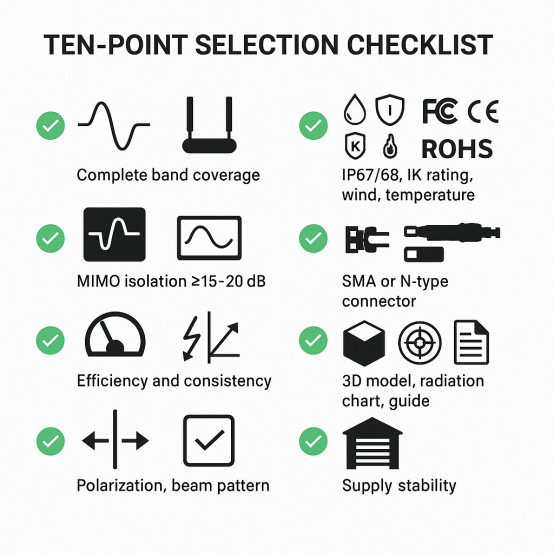
5.2 Selection Checklist (10 Points)
Full band coverage (n41/n77/n78, Wi-Fi, GNSS), complete out-of-band suppression curves.
MIMO isolation ≥ 15–20 dB.
VSWR ≤ 2:1, flat in-band, with S-parameters.
Prioritize efficiency and in-band consistency over peak gain.
Polarization and beamwidth match the scenario.
Complete IP67/68, UV/salt-fog, IK, wind load, torque, and temperature specs.
Meets FCC/CE, PTCRB, automotive/rail, RoHS/REACH certifications.
Interfaces match site needs, with complete accessories.
Provides 3D models, radiation patterns, and installation guides for simulation and construction.
Stable supply, consistent batches, with backup options.
5.3 Quoting and Sampling Process
Sample before bulk orders, blind-test 2–3 models, compare RSRP/SINR/throughput/latency.
Test at actual installation sites, not on a bench.
Record polarization, orientation, coax type/length; change one parameter at a time.
Test across operators if needed.

5.4 Backup Materials and Risk Mitigation
Select backup models with matching bands/polarization/efficiency/interfaces.
Stock bulkhead and SMA↔N-Type adapters to avoid multi-stage transitions.
Prepare LMR-240 (≤10 m), LMR-400 (>10 m), jumpers ≤1–2 m.
Retest and update baselines after antenna swaps.
5.5 Common Selection Mistakes
Focusing only on gain, ignoring efficiency, in-band consistency, or coax loss.
Multi-system antennas too close, causing interference.
Ignoring ground plane/height requirements, distorting low-profile antenna radiation.
Neglecting wind load/torque, leading to long-term drift.
Ordering without complete datasheets, complicating troubleshooting.
6. Selection Decision Tree (Quick Implementation)
6.1 Scenario Input Card
Mobility/Orientation: Static | Low-speed | High-speed
Distance and Service: Near/medium/long range, target uplink rate, 95th percentile latency, availability
Bands and Interference: Operator bands, Wi-Fi/GNSS inclusion, electrical noise level
Installation Conditions: Indoor/outdoor/vehicle/cabinet, metallic ground availability, max coax length
Environment and Compliance: IP/IK, lightning/grounding, temperature, wind load requirements
6.2 Decision Steps
Omni vs. Directional: Mobile/multipath → omnidirectional; long-range/congested → directional (panel preferred).
MIMO & Polarization: Start with 2×2, upscale to 4×4 for >30 Mbps uplink or capacity bottlenecks; cellular vertical/±45°, Wi-Fi cross-polarized.
Form Factor: Metallic ground → low-profile/combo; pole/rooftop → panel/collinear; space-constrained → FPC/ceramic.
Coax Selection: ≤2 m jumper, 2–10 m LMR-240, >10 m LMR-400; prioritize shorter cables over thicker ones.
Lightning/Environment: Outdoor requires surge protectors and short grounding; verify IP/IK, temperature, wind load, GNSS sky view.

6.3 Quick Recommendations (Scenario → Solution)
Surveillance Poles: Directional panel ±45° (2×2/4×4) + short LMR-240 + lightning protection.
Elevators/Warehouses: Leaky cable/indoor distribution preferred; else, low-profile omni on cabin top + directional panel in machine room.
AGVs/AMRs: Low-profile omni 2×2 (cellular) + zoned Wi-Fi 2×2, ≥0.5λ spacing.
Vehicles/Rail: Roof-mounted combo (cellular 2×2/4×4 + GNSS + Wi-Fi 2×2), metallic ground, lightning protection.
Mines/Wind Farms: Directional panel/Yagi + LMR-400 + corrosion-resistant masts.
Factories/Warehouses: Outdoor omni + indoor distribution; cross/±45° omni for complex multipath; Wi-Fi 6/6E zoning.

6.4 Acceptance Criteria
Cellular Metrics: RSRP > −95 dBm, SINR > 5–10 dB, packet loss <1%, 95th percentile latency compliant.
Documentation: Photos, orientation/polarization, MIMO spacing, coax type/length, lightning/grounding details.
Optimization: Change one parameter at a time, compare and archive results.

7. Installation and Position Optimization Methods
7.1 Five Installation Principles
Elevate and Clear Obstructions: Prioritize high positions, avoid walls, beams, metal boxes, or cable bundles.
Avoid Interference: Keep 0.5–1 m from large metal, motors, or inverters; cross at 90° if separation isn’t possible.
Polarization/MIMO Matching: Cellular vertical or ±45° dual-polarized, Wi-Fi cross-polarized; MIMO spacing ≥0.5λ, symmetrical/orthogonal for isolation.
Short, Low-Loss Coax: Prioritize LMR-240/400, minimize adapters, tighten connectors to torque, seal with self-amalgamating + PVC tape.
Document Installation: Photograph orientation, polarization, spacing, coax type/length for reproducibility and optimization.
7.2 Layout and Alignment
MIMO Layout: 2×2 ≥0.5λ, 4×4 diagonal if possible, mix vertical/±45°.
Metallic Ground: Provide continuous ground for vehicle/cabinet; add metal plate for non-metallic roofs.
Directional Tuning: Rough align, then fine-tune ±5–10° for optimal throughput/latency.
7.3 Coax and Sealing
≤2 m jumper, 2–10 m LMR-240, >10 m LMR-400; shorter is better.
Minimize adapters, use drip loops; double-seal outdoor connectors, use IP67/68 gland seals for pass-throughs.
7.4 KPI-Driven Optimization
Baseline Measurement: Measure RSRP, SINR, throughput, 95th percentile latency immediately after installation.
Single-Factor Adjustment: Change one parameter (height, orientation, polarization, spacing, coax) at a time.
Thresholds: RSRP > −95 dBm, SINR > 5–10 dB, packet loss <1%; prioritize position and coax optimization.
7.5 Quick Troubleshooting (Symptom → Action)
Poor RSRP: Elevate → reposition → switch to high-gain → shorten coax.
Poor SINR: Move away from noise → adjust polarization/spacing → use directional antennas.
Low Throughput: Check MIMO isolation, carrier aggregation, coax loss.
Day/Night Variations: Use directional backhaul, cell reselection, polarization tweaks.
Frequent Dropouts: Inspect connectors for looseness/water, coax damage, grounding failures.
8. Typical Industrial Scenarios (Scenario → Recommendation → Pitfalls → Acceptance)
8.1 Smart City Surveillance (Intersections/Parks/Poles)
Recommendation: Directional panel ±45° (2×2, 4×4 for congested areas) + short LMR-240 + N-Type outdoor components + lightning/grounding.
Installation/Pitfalls: Align main lobe to aggregator/base station; avoid pole shadows or camera metal coupling; ensure mast meets wind load/torque specs.
Acceptance KPIs: Uplink ≥ 10–20 Mbps; RSRP > −95 dBm, SINR > 7–10 dB; 95th percentile latency < 120 ms; retest during peak evening hours.
8.2 Elevators/Automated Warehouses (High Occlusion/Strong Metal)
Recommendation: Leaky cable/indoor distribution preferred; else, low-profile omni on cabin top + directional panel in machine room. Use short coax, RG for jumpers only.
Installation/Pitfalls: Keep away from cables/counterweights; antennas ≥0.25–0.5λ from shaft walls; ensure machine room/shaft equipotential and lightning protection.
Acceptance KPIs: Seamless floor transitions; zero dropped calls/alarms; uplink/downlink ≥ target × 1.2; stability during stops/acceleration.
8.3 AGVs/AMRs and Production Robots (Low-Speed Movement/Electrical Noise)
Recommendation: Low-profile omni 2×2 (cellular) + zoned Wi-Fi 2×2; ≥0.5λ spacing; solid metallic ground.
Installation/Pitfalls: Keep ≥0.5–1 m from inverters/servos/brushes; separate cellular/Wi-Fi routing; RG-316 for ≤1–2 m jumpers only.
Acceptance KPIs: <1% packet loss at cruising speed; 95th percentile latency compliant; SNR/SINR fluctuation within thresholds; retest during turns/metal passages.
8.4 Vehicles/Rail (High-Speed Movement/Handover-Sensitive)
Recommendation: Roof-mounted combo (cellular 2×2/4×4 + GNSS + Wi-Fi 2×2), continuous metallic ground, LMR-240 (≤10 m)/LMR-400 (>10 m).
Installation/Pitfalls: Tighten to manufacturer torque; ensure GNSS sky view; add metal plate for non-metallic roofs; nearby lightning/grounding.
Acceptance KPIs: No interruptions at high speed; GNSS fix time and track continuity compliant; seamless voice/data handovers; retest after rain/vibration.
8.5 Energy/Mining/Wind Farms (Long-Range/High Wind/Salt Fog)
Recommendation: Directional panel/Yagi aligned to base station; LMR-400 long coax; corrosion-resistant masts with downleads.
Installation/Pitfalls: Verify wind load/torque ratings; seal/corrosion-proof all exposed connectors; use drip loops and UV-resistant coax; regular tightening patrols.
Acceptance KPIs: Uplink meets project specs; 24h curve without major fluctuations; retest RSRP/SINR and mechanical drift after storms.
8.6 Factories/Warehouses (Complex Multipath/Multi-Point Coverage)
Recommendation: Outdoor omni + indoor distribution; cross/±45° omni for multipath; Wi-Fi 6/6E zoning and channel planning.
Installation/Pitfalls: Avoid periodic occlusion by cranes/high racks; physically separate cellular backhaul and Wi-Fi APs; unified grounding/equipotential.
Acceptance KPIs: Roaming interruptions <150 ms; uplink/downlink meet thresholds; retest during peak shifts; dropout/retry rates compliant.
8.7 On-Site Documentation
Photos: Installation position, orientation/pitch, polarization, spacing, cable routing, gland/sealing details.
Parameters: Antenna model, coax type/length, lightning/grounding method.
Baseline: RSRP/RSRQ/SINR, throughput, 95th percentile latency, packet loss; retest records for special actions (turns, elevation, post-storm).
9. Debugging and Acceptance Process
9.1 Pre-Test Preparation
Prepare test terminal/app, laptop with iperf3, GNSS tools, Wi-Fi analyzer, torque wrench, PPE; confirm SIM/APN/VPN, band-locking/CA/NR settings; prepare logging forms.
9.2 On-Site Process
Baseline Survey: Pre-installation three-point test, record RSRP/RSRQ/SINR, PCI, NR-ARFCN, RSSI.
Post-Installation Test: Measure 95th percentile metrics, run iperf3 for 3×60s, test uplink/downlink throughput, ping RTT/packet loss.
Single-Factor Adjustment: Adjust height → orientation → polarization → spacing → coax, one at a time, with photos.
Scenario Testing: Evening peak, elevator travel, vehicle cruising, post-storm retests.
24h Stability: Continuously log RSRP/SINR, throughput, RTT/packet loss, record dropout/handover times.
9.3 Acceptance KPIs
RSRP > −95 dBm, SINR > 7–10 dB, uplink ≥ target × 1.5, 95th percentile latency < 120 ms, packet loss <1%.
Wi-Fi RSSI > −65 dBm, roaming interruptions <150 ms.
GNSS TTFF < 30s, continuous track.
No water ingress in connectors, pole drift < 5°.
9.4 Quick Diagnostics
Low Throughput: Check MIMO isolation, CA status, rate limits, or server bottlenecks.
Low RSRP: Elevate, reposition, switch to high-gain, shorten coax.
Low SINR: Move away from noise, adjust polarization/spacing, use directional antennas.
High Latency Jitter: Cell reselection, band locking, directional backhaul.
Intermittent Dropouts: Inspect connectors for looseness/water, coax damage, grounding, SIM contact, or base station maintenance.
Unstable VPN: Adjust MTU (1400/1420/1450), prioritize UDP.
9.5 Delivery and Archiving
Archive installation photos, parameters, baselines, reports; use consistent version naming; log changes with rollback points and retest updates.
10. Safety and Compliance
10.1 Construction and Height Safety
Wear PPE, use dual-anchor points for climbing, halt work during storms; follow LOTO for electrical work, adhere to torque specs, secure high equipment against falls.
10.2 Grounding and Lightning Protection
Topology: Antenna → surge protector → entry point → device. Use short, direct downleads, equipotential grounding, corrosion-proofing; retest grounding resistance and drift post-storm.
10.3 EMC and RF Compliance
Ensure FCC/CE/PTCRB certifications, outdoor components meet IP67/IK/UV/salt-fog ratings, route cables in separate layers/slots, cross at 90°, avoid long parallel runs.
10.4 Data and Network Security
Use VPN/IPsec/ACL, firewalls, strong passwords, certificate authentication; enable sanitized logging, versioned configuration/firmware management.
10.5 Documentation and Incident Response
Archive construction plans, grounding measurements, certifications, photos; follow “three cuts, one check” for incidents, replace damaged parts, retest KPIs, update site manuals.
11. Maintenance and Lifecycle
11.1 Inspection Cadence
Monthly visual checks; quarterly metric retests and torque/orientation verification; annual internal checks for grounding, surge protectors, and corrosion; post-extreme weather inspections.
11.2 Online Monitoring
Continuously log RSRP, SINR, throughput, RTT; trigger alerts for >20% drops; monitor VSWR, port temperature, reboot counts.
11.3 Spares and Backup Materials
Keep 1:10 spares for antennas, coax, jumpers, surge protectors, gland seals; specify equivalent backups, retest baselines after replacements.
11.4 Aging and Environmental Countermeasures
Replace cracked/salt-corroded parts; regularly check panel/Yagi drift; optimize cooling and cable fixing in high-temperature zones.
11.5 Change Management
Log changes to position, orientation, coax, firmware, or bands; set rollback points, execute single-factor changes, retest and update reports.
11.6 Upgrades and Rollbacks
Validate firmware/configurations in a sandbox, test across operators, rollback immediately if degraded.
11.7 Supply and Version Management
Archive by site-date-version, sample new batches, prepare backup plans; allow sufficient windows for EOL equipment replacement.
11.8 Decommissioning and Data Security
Replace damaged parts, wipe data before decommissioning, require dual verification for handovers.
12. Summary
Through scientific antenna selection, standardized installation, and data-driven optimization, industrial router antennas transition from “art” to a designable, verifiable, and reproducible engineering process. Treating antennas as the starting point of the link unlocks network bandwidth potential, enhances service continuity, and lays a solid foundation for maintenance and scalability.


