
PoE PD / PoE IN and PSE / PoE OUT Deep Dive
Power over Ethernet Architecture Analysis for Industrial Routers and IoT Devices
— Wavetel IoT Technical White Paper —
Table of Contents
PoE Technology Overview: Why Industrial Sites Increasingly Depend on PoE
What is PD / PoE IN (Powered Device)
What is PSE / PoE OUT (Power Sourcing Equipment)
Typical PoE IN and PoE OUT Architectures in Industrial Routers
Engineering Value of Integrated PD + PSE Design
PoE Selection and Project Implementation Considerations
PoE Technology Overview: Why Industrial Sites Increasingly Depend on PoE
In today's rapidly developing Industrial Internet of Things (IIoT), Power over Ethernet (PoE) technology has become an indispensable infrastructure for modern industrial deployments. PoE technology allows simultaneous transmission of data and power through standard Ethernet cables, greatly simplifying device installation and maintenance complexity.
Core Value of PoE
Simplified Cabling: One cable solves both power and communication, reducing cabling costs by 40-60%
Flexible Deployment: No power outlets required - devices can be installed anywhere with network coverage
Centralized Management: Centrally control device power through the network, enabling remote restart and power management
Safe and Reliable: Low-voltage power supply (typically 48V DC), compliant with safety standards, reducing electrical risks
Rapid Deployment: Especially suitable for temporary scenarios, leased premises, and rapidly expanding IoT projects
PoE Advantages in Industrial Scenarios
In industrial environments such as smart factories, smart cities, and energy monitoring, PoE technology solves many pain points of traditional power supply methods:
Harsh Environments: Reduces electrical connections and contact points, improving system reliability
Remote Sites: No separate power wiring required, reducing construction difficulty
Rapid Expansion: Adding new devices doesn't require electrical work - plug and play
Simple Maintenance: Centralized power management, remote diagnostics and restart
Traditional vs PoE Power Supply Comparison
Traditional Solution | PoE Solution |
Power cable + Network cable | PoE cable (Data + Power) |
= Double cabling cost | = All-in-one |
PoE Application Trends in Industrial IoT
Smart Surveillance: IP cameras and access control systems powered via PoE for seamless coverage
Wireless Coverage: Industrial APs and wireless bridges flexibly deployed in locations without power
Sensor Networks: Environmental monitoring and equipment status sensors with centralized power management
Edge Gateways: Industrial routers and edge computing devices with simplified field deployment

What is PD / PoE IN (Powered Device)
2.1 Concept Explanation
PD (Powered Device) refers to devices that can receive power through Ethernet cables. On device interfaces, it's typically labeled as PoE IN or PoE-PD.
PD Working Principle
Detection Phase: PSE detects whether a legitimate PD device exists downstream through specific resistance
Classification Phase: PD identifies its power class requirements to PSE
Power Supply Phase: PSE provides corresponding power according to PD requirements, typically 48V DC
Maintenance Phase: PSE continuously monitors PD status, detecting disconnection or overload
PoE PD Power Reception Process
PSE Detection → PD Response → Power Negotiation → 48V Power Supply → Device Operation

2.2 Common PD Devices
Device Type | Typical Power | PoE Standard | Application Scenario |
IP Camera | 4-15W | 802.3af/at | Video surveillance, smart security |
Wireless AP | 15-30W | 802.3at (PoE+) | Enterprise Wi-Fi, factory wireless coverage |
Industrial Router | 12-25W | 802.3at | Edge gateway, data acquisition |
IP Phone | 3-7W | 802.3af | VoIP communication systems |
Access Controller | 5-15W | 802.3af/at | Smart access control, attendance systems |
Sensor Node | 1-5W | 802.3af | Environmental monitoring, industrial sensing |
2.3 Value of Industrial Routers as PD
Modern industrial routers support PoE IN functionality and can act as PD devices to obtain power from upstream PoE switches or injectors. This has significant value in the following scenarios:
Industrial Router PoE-PD Application Advantages
Outdoor Deployment Scenarios
· Smart streetlight controllers: No 220V power on light poles, powered via PoE from ground cabinets
· Traffic monitoring points: Network cables only on road monitoring poles, routers powered via PoE
Temporary Projects and Rapid Deployment
· Construction site temporary networks: No electrical work required, quick wireless network setup
· Exhibitions and events: Quick deployment in leased venues, fast dismantling
Centralized Power Management
· UPS protection: PoE switches in equipment rooms connected to UPS for unified power failure protection
· Remote restart: Remotely turn off/on PoE ports via managed switches for device restart
Reduced Construction Costs
· Save 50-70% on power cable material costs
· Reduce electrical construction hours by 40-60%
· Lower subsequent maintenance difficulty
Wavetel WR143 - Typical PoE-PD Industrial Router
Features:
· ✓ Supports 1×PoE-PD FE port, compatible with 802.3af/at standards
· ✓ 4G LTE Cat 4 wireless connectivity, suitable for remote sites
· ✓ Compact design, easy installation in confined spaces
· ✓ Industrial temperature range -40°C ~ 75°C
· ✓ Application scenarios: Digital signage, smart vending machines, environmental monitoring stations
What is PSE / PoE OUT (Power Sourcing Equipment)
3.1 Concept Explanation
PSE (Power Sourcing Equipment) refers to devices that can provide power to downstream PD devices through Ethernet cables. On device interfaces, it's typically labeled as PoE OUT or PSE Port.
PSE Power Supply Mechanism
· Endpoint Supply (Endspan): PoE switches integrate power supply functionality in network devices
· Midspan Supply (Midspan): PoE injectors add power supply capability to existing networks
· Intelligent Allocation: Dynamically adjust power per port according to PD device requirements
· Safety Protection: Overload protection, short-circuit protection, automatic disconnection mechanism
PSE Power Supply Topology
Upstream Power Source (AC/DC Adapter)
↓
PSE Device (PoE Switch/Router)
↓
┌───────┼───────┐
↓ ↓ ↓
PD Device 1 PD Device 2 PD Device 3
(Camera) (AP) (Sensor)
3.2 Common PSE Devices
PSE Device Type | Port Count | Total Power Budget | Typical Application |
Small PoE Switch | 4-8 ports | 60-120W | Small offices, retail stores |
Medium PoE Switch | 16-24 ports | 180-370W | Enterprise networks, smart buildings |
Large PoE Switch | 48+ ports | 740W+ | Data centers, campus networks |
PoE Injector | 1 port | 15-30W | Single device retrofit, temporary power |
Industrial PoE Router | 1-4 ports | 30-90W | Edge gateway, field device power |
3.3 Significance of Industrial Router PoE OUT Support
When industrial routers integrate PoE OUT (PSE) functionality, they become not only network connection devices but also edge power hubs with important engineering value:
Industrial Router PoE-PSE Core Value
Edge Power Hub Industrial routers, as the network core in the field, can directly power surrounding IoT devices without requiring additional PoE switches, simplifying architecture.
Reduced Total Cost
· Avoid purchasing separate PoE switches (save 500-2000 yuan/location)
· Reduce device count, lowering failure points
· Simplify cabling and maintenance
Flexible Topology Deployment
· Industrial routers connect via 4G/5G while powering local cameras and APs
· Suitable for remote sites without wired network coverage
· Support star, chain, and other topologies
Industrial-Grade Reliability
· Wide temperature design: -40°C ~ 75°C
· Overload protection, automatic recovery
· Strong electromagnetic compatibility
Wavetel - Typical PoE-PSE Industrial Router
Product Features:
· ✓ 1×WAN + 1×LAN + 1×PoE OUT (PSE) port configuration
· ✓ PoE OUT port supports 802.3af/at, maximum 30W output
· ✓ 4G LTE Cat 4 or Wi-Fi uplink connectivity
· ✓ Industrial-grade metal housing, DIN rail/wall mount installation
· ✓ Application scenarios: Providing network and power to IP cameras, wireless APs, sensors
PSE Design Considerations
Power Budget: Ensure PSE total power can meet all PD device requirements, reserve 20% margin
Cable Quality: Use Cat5e or higher standard cables, maximum transmission distance 100 meters
Compatibility Testing: Different manufacturer devices may have negotiation issues, recommend early testing
Heat Dissipation Design: High-power PSE devices require good heat dissipation to avoid overheating derating
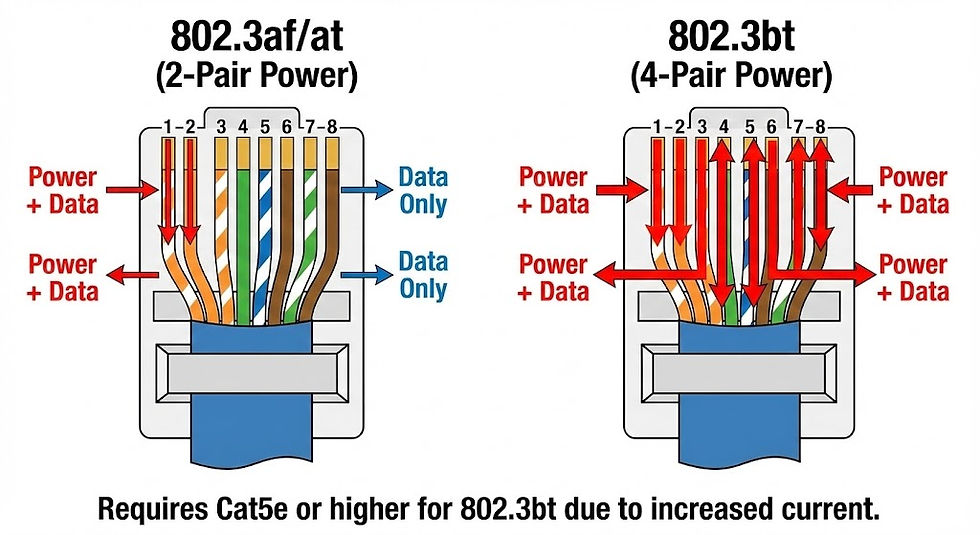
PoE Standards Explained: 802.3af / at / bt
IEEE has defined three generations of main PoE standards, with power increasing in each generation to meet the power supply requirements of different devices:
Standard | Release Year | Alias | PSE Max Output | PD Max Power | Typical Application |
802.3af | 2003 | PoE / PoE Type 1 | 15.4W | 12.95W | IP phones, simple cameras, sensors |
802.3at | 2009 | PoE+ / PoE Type 2 | 30W | 25.5W | IP cameras (PTZ), wireless APs, tablets |
802.3bt | 2018 | PoE++ / 4PPoE | 60W / 100W | 51W / 71W | LED lighting, displays, laptops, high-performance devices |
Power Loss Explanation
From the table above, we can see there's a difference between PSE output power and PD received power due to:
· Cable resistance loss: 100m Cat5e cable loses approximately 2-4W
· Connector loss: RJ45 connectors and terminals lose approximately 0.5-1W
· Design margin: Safety margin reserved by standards
Practical Engineering Recommendation: When selecting PSE power, consider PD requirements × 1.3 times
802.3bt (PoE++) Major Breakthrough
Type 3 (60W):
· Uses all 4 pairs of cables for power (previously only 2 pairs)
· Supports high-performance wireless APs, small displays
· Suitable for LED smart lighting systems
Type 4 (100W):
· Can power laptops and large displays
· Supports industrial automation high-power devices
· Achieves true "single-cable solution" vision
Standard Comparison
802.3af - Entry Level
· Power: 12.95W (PD)
· Power Pairs: 2 pairs
· Applications: IP phones, simple cameras, access card readers, basic sensors
802.3at - Mainstream Level
· Power: 25.5W (PD)
· Power Pairs: 2 pairs
· Applications: PTZ cameras, enterprise APs, industrial routers, video phones
802.3bt - High Power
· Power: 51W / 71W (PD)
· Power Pairs: 4 pairs
· Applications: LED lighting, digital signage, thin clients, industrial controllers
Backward Compatibility
PoE standards fully considered backward compatibility during design:
· 802.3at PSE can power 802.3af PD (automatically reduces power)
· 802.3bt PSE can power af/at PD
· PD devices only request the power they need, won't overload
· Recommend directly adopting 802.3at or higher standards in new projects to ensure future scalability
Typical PoE IN and PoE OUT Architectures in Industrial Routers
Modern industrial routers can be configured with three typical PoE architectures based on different application scenarios:
5.1 PoE IN Only (PD Mode)
Architecture Features: Router as powered device
Topology:
Upstream PoE Switch/Injector (PSE)
↓ PoE Power + Data
Industrial Router (PoE-PD)
(Only receives power, no output)
↓ 4G/5G/Wi-Fi
Internet / Cloud Platform
Typical Product: Wavetel WR143 Series
Application Scenarios:
· ✓ Outdoor monitoring points: Router installed on monitoring poles, powered via PoE from ground cabinets
· ✓ Remote sites without power: Long-distance Ethernet power supply with 4G backhaul
· ✓ Temporary deployment scenarios: Quick setup, no electrical work required
· ✓ Smart buildings: Each floor powered via PoE for floor routers
5.2 PoE OUT Only (PSE Mode)
Architecture Features: Router as power sourcing device
Topology:
DC Power Adapter (12V/24V/48V)
↓ DC Power
Industrial Router (PSE)
(Powers via PoE OUT ports)
↓ ↓ ↓
IP Camera Wireless AP Sensor
(PD) (PD) (PD)
Application Scenarios:
· ✓ Edge power hub: Router connects via 4G while powering local devices
· ✓ Small surveillance systems: Router + 1-2 cameras integrated solution
· ✓ Wireless coverage extension: Router provides network and power to downstream APs
· ✓ Industrial sensor networks: Router powers multiple sensor nodes and organizes network
5.3 PoE IN + PoE OUT (Integrated Architecture)
Architecture Features: Router supports both power reception and power supply
Topology:
Upstream PoE Switch (PSE)
↓ PoE Power IN
Industrial Router (PD + PSE Integrated)
(Receives power + Transfers power)
↓ ↓
Device A Device B
(PD) (PD)
Core Advantages:
· Simplified Architecture: Router itself doesn't need independent power, transfers power downstream after receiving from upstream
· Flexible Expansion: Can be inserted into existing PoE networks to extend power supply range
· Reduced Costs: Save independent power supply and PoE switch investment
· Centralized Management: Entire chain power uniformly controlled by core PoE switch
Application Scenarios:
· ✓ Chain deployment: Extend network and power along corridors, roads and other linear spaces
· ✓ Star expansion: Branch out from backbone PoE network, extend coverage
· ✓ Hierarchical architecture: Distributed deployment by floor, each floor router receives power from upper floor and supplies power locally
· ✓ Quick addition: Add nodes to existing PoE systems without modification
Architecture Selection Recommendations
Choose PoE IN (PD): When router deployment location has difficulty obtaining 220V power but has PoE network coverage
Choose PoE OUT (PSE): When router serves as edge gateway and needs to power surrounding IoT devices
Choose PD+PSE: When flexible expansion in existing PoE systems is needed, or building multi-level PoE power supply networks

Application Scenarios with Wavetel IoT Industrial Routers
Wavetel IoT specializes in industrial-grade cellular routers and gateway products. Many routers support PoE functionality. Here are typical application scenarios:
Scenario 1: Smart City - Intelligent Street Lighting Network Project
Project Requirements A city plans to upgrade 5000+ street lights with smart features for remote control, brightness adjustment, and fault detection.
Technical Challenges:
· No 220V mains power access point on light poles
· High wiring costs (each pole requires separate power)
· Long construction period affecting traffic
Wavetel Solution:
Ground Cabinet PoE Switch → Light Pole Wavetel Router (PoE-PD) → 4G Backhaul to Cloud Platform
Solution Advantages:
· ✓ Unified power supply from ground cabinets through existing power corridors
· ✓ Pole routers powered via PoE, no secondary construction needed
· ✓ 4G wireless backhaul, no fiber coverage required
· ✓ Reduce wiring costs by 60%, shorten construction period by 50%
Scenario 2: Industrial Park - Smart Surveillance and Wireless Coverage
Project Requirements An industrial park needs to deploy surveillance cameras and wireless APs around workshop perimeters for security and employee Wi-Fi coverage.
Technical Challenges:
· No network and power infrastructure around workshop perimeter
· Cameras and APs distributed deployment, high individual wiring costs
· Need rapid deployment without affecting production
Wavetel Solution (PoE OUT Architecture):
Wavetel (4G Router + PoE OUT)
↓ ↓
IP Camera 1 Outdoor AP
Solution Advantages:
· ✓ Router only needs one DC power supply (can be solar)
· ✓ Powers camera and AP simultaneously through PoE OUT port
· ✓ 4G backhaul for surveillance video and management data
· ✓ Each location saves approximately 1500 yuan in independent power and switch costs
Scenario 3: Smart Agriculture - Environmental Monitoring and Automation Control
Project Requirements A smart farm needs to deploy temperature/humidity sensors, CO₂ monitors, and automation controllers in greenhouse facilities.
Technical Challenges:
· Humid greenhouse environment, high electrical safety requirements
· Sensor nodes distributed, complex wiring
· Need remote monitoring and data backhaul
Wavetel Solution (PD + PSE Integrated):
Greenhouse Control Room PoE Switch
↓ PoE IN
Wavetel Router (PD + PSE)
↓ ↓ ↓
Temp/Humidity CO₂ Monitor Controller
Solution Advantages:
· ✓ Unified power management from control room, 48V low-voltage safe power supply
· ✓ Router powered via PoE IN, no independent power needed
· ✓ Powers sensors via PoE OUT, simplified wiring
· ✓ 4G network backhauls data to cloud platform for remote management
Wavetel Product Core Competitiveness in PoE Applications
Industrial-Grade Reliability
· -40°C ~ 75°C wide temperature design
· Adapts to harsh outdoor environments
Flexible Power Solutions
· Supports PoE / DC / AC multiple power methods
Multiple Network Access
· 4G / 5G / Wi-Fi / Wired combined connectivity
Enterprise-Grade Security
· VPN / Firewall encrypted data transmission protection
Remote Operations
· Cloud platform management batch configuration and monitoring
Industrial Protocol Support
· Modbus / MQTT seamless integration with industrial control systems
Engineering Value of Integrated PD + PSE Design
PoE PD + PSE integrated routers represent the development trend of industrial IoT edge devices with significant engineering and economic value:
7.1 Architecture Simplification Value
Traditional Solution | PD+PSE Integrated Solution |
Equipment List: | Equipment List: |
- PoE Switch × 1 | - PD+PSE Router × 1 |
- Industrial Router × 1 | - Upstream PoE Power (existing) |
- Power Adapters × 2 | - Mounting Bracket × 1 |
- Mounting Brackets × 2 |
|
Cost: ~3500-5000 yuan | Cost: ~1800-2800 yuan |
Failure Points: 4 devices | Failure Points: 1 device |
| �� Save 40-50% Cost |
7.2 Power Cascading and Supply Topology
PD+PSE integrated design supports multi-level cascading to build flexible power supply topology:
Three-Level PoE Cascade Example:
Level 1: Core PoE Switch (Total Power 370W)
↓
┌───────┼───────┐
↓ ↓ ↓
Level 2: PD+PSE Router A/B/C (Receive 25W / Supply 30W)
↓ ↓ ↓
Level 3: Camera A1 / AP B1 / Sensor C1
(12W) (15W) (5W)
Cascade Power Supply Considerations
1. Power Margin: Each level conversion loss approximately 10-15%, need to reserve power margin
2. Cascade Levels: Recommend no more than 3 levels to avoid excessive loss and management complexity
3. Cable Quality: Use Cat6 or higher standards to ensure transmission quality
4. Total Distance Limit: Each segment 100m, multi-level cascading note cumulative distance impact on signal

7.3 Typical Engineering Scenario Comparison Analysis
Evaluation Dimension | Traditional PSE + Router | PD+PSE Integrated | Advantage Improvement |
Initial Investment | 3500-5000 yuan/location | 1800-2800 yuan/location | Save 40-50% |
Construction Hours | 4-6 hours/location | 1-2 hours/location | Reduce 60-70% |
Failure Rate | Higher (multiple devices) | Low (single device) | Reduce 50%+ |
Maintenance Cost | High (multiple on-site visits) | Low (remote management) | Save 40% |
Expansion Flexibility | Average | Excellent (cascading) | Significantly Improved |
Cabinet Space | Occupies 2U+ | Occupies 0.5U | Save 75% |
Investment Return Analysis (Based on 50-Location Project)
Traditional Solution Total Cost:
· Equipment cost: 3500 × 50 = 175,000 yuan
· Construction cost: 500 × 50 = 25,000 yuan
· Annual maintenance cost: 200 × 50 = 10,000 yuan
· Three-year total cost: 230,000 yuan
PD+PSE Integrated Solution:
· Equipment cost: 2000 × 50 = 100,000 yuan
· Construction cost: 150 × 50 = 7,500 yuan
· Annual maintenance cost: 100 × 50 = 5,000 yuan
· Three-year total cost: 122,500 yuan
Investment Savings: 107,500 yuan (46.7%)
Payback Period: Approximately 6-8 months
PoE Selection and Project Implementation Considerations
8.1 PoE Device Selection Checklist
Selection Dimension | Key Parameters | Considerations |
PoE Standard | af / at / bt | Select based on PD device power, reserve 20% margin<br>Recommend prioritizing 802.3at or higher |
Port Count | 1-48 ports | Consider 3-5 year expansion needs<br>Reserve 30% port margin |
Total Power Budget | 60W - 1000W+ | Actual PD total requirement × 1.3 times<br>Avoid full load operation, extend device lifespan |
Management Function | Managed / Unmanaged | Industrial projects recommend managed type<br>Support port monitoring, remote restart, VLAN |
Environmental Grade | Industrial / Commercial | Outdoor/harsh environments must select industrial grade<br>-40°C ~ 75°C wide temperature range |
Protection Rating | IP30 / IP65+ | Outdoor deployment select IP65 or higher<br>Dust and water protection |
Installation Method | Desktop / Rack / Rail | Industrial scenarios prefer DIN rail<br>Save space, convenient maintenance |
Redundant Power | Single / Dual power | Mission-critical applications select dual power<br>Improve system availability |
8.2 Cable Selection and Wiring Standards
PoE Cable Requirements
Cable Types:
· Cat5e: Supports 802.3af/at, maximum 1000Mbps
· Cat6: Supports 802.3bt Type 3, maximum 1000Mbps, recommended
· Cat6a/Cat7: Supports 802.3bt Type 4, maximum 10Gbps
Transmission Distance:
· Standard maximum distance: 100 meters (from PSE to PD)
· Beyond 100m requires PoE repeater or fiber conversion
· Longer distances require higher cable quality
Wiring Considerations:
· ✓ Avoid parallel routing with high-voltage cables (maintain 30cm+ spacing)
· ✓ Keep 90° perpendicular when crossing
· ✓ Avoid excessive bending (bend radius > 4× cable diameter)
· ✓ Select waterproof, UV-resistant cables for outdoor wiring
· ✓ Use shielded cables to reduce EMI interference
8.3 Power Calculation and Margin Design
PoE Power Calculation Formula
PSE Power Requirement = Σ(PD Power) × 1.3 + System Loss
Example Calculation:
· 4 IP cameras @ 15W = 60W
· 2 wireless APs @ 25W = 50W
· 1 router @ 12W = 12W
· Subtotal: 122W
· Safety factor 1.3: 122 × 1.3 = 158.6W
· Recommended PSE power: ≥ 180W
Common Power Configuration Errors
Error 1: Selecting based on theoretical maximum power without margin→ Actual load fluctuations may cause unstable power supply
Error 2: Ignoring cable loss→ Long-distance transmission power attenuation is severe
Error 3: Mixing devices of different standards→ May result in negotiation failure or insufficient power
Correct Approach:
· Select based on actual requirements × 1.3 times
· Long distance (>50m) add 20% power margin
· Prioritize devices supporting LLDP protocol for automatic power negotiation
· Conduct compatibility testing before deployment
8.4 Key Project Implementation Steps
1. Requirements Analysis → 2. Solution Design → 3. Equipment Procurement →
4. Field Testing → 5. System Delivery
8.5 Common Troubleshooting
Fault Symptom | Possible Causes | Solutions |
PD device not powered | • Cable issues<br>• PSE port failure<br>• PD incompatible | 1. Replace cable for testing<br>2. Change PSE port<br>3. Check device standard compatibility |
Frequent disconnection after power | • Insufficient power<br>• High cable loss<br>• Poor contact | 1. Upgrade PSE power class<br>2. Shorten distance or upgrade cable<br>3. Check RJ45 connector |
Data transmission anomaly | • Poor cable quality<br>• EMI interference<br>• Wiring error | 1. Use Cat6 or higher cables<br>2. Use shielded cable<br>3. Test wire sequence |
PSE overheating protection | • Excessive load<br>• Poor heat dissipation<br>• High ambient temperature | 1. Reduce PD count<br>2. Improve ventilation<br>3. Add cooling fans |
Conclusion
PoE technology is increasingly widely used in industrial IoT and has become an important means of simplifying deployment, reducing costs, and improving reliability. This article systematically explains the technical principles, standard evolution, and practical applications of PoE PD/IN and PSE/OUT:
Key Points Summary
Technical Foundation
· PD (PoE IN): Powered device, receives power from network cable
· PSE (PoE OUT): Power sourcing equipment, provides power through network cable
· Standard Evolution: 802.3af (15W) → 802.3at (30W) → 802.3bt (60W/100W)
Architecture Modes
· PD only: Suitable for edge device power reception
· PSE only: Suitable for edge power hub
· PD+PSE: Integrated cascading, most flexible
Engineering Value
· Reduce 40-50% deployment costs
· Reduce 60-70% construction hours
· Reduce 50%+ device failure rate
· Improve system flexibility and scalability
Application Prospects
· Core infrastructure technology for smart cities, Industry 4.0, smart buildings, smart agriculture and other fields
Key Takeaways
1. Standard Selection: New projects prioritize 802.3at or higher standards to ensure compatibility and future expansion
2. Power Design: Select based on actual requirements × 1.3 times, reserve sufficient margin
3. Architecture Planning: PD+PSE integrated routers can greatly simplify system architecture and reduce costs
4. Cable Quality: Use Cat6 or higher standards to ensure long-distance transmission quality
5. Industrial-Grade Selection: Outdoor and harsh environments must select industrial-grade equipment, -40°C ~ 75°C wide temperature range
6. Compatibility Testing: Different manufacturer devices require sufficient testing before deployment
7. Centralized Management: Select PSE devices supporting management functions for remote monitoring and maintenance
Wavetel IoT PoE Solution Advantages
As a professional industrial IoT equipment provider, Wavetel IoT offers comprehensive PoE product lines and solutions:
✓ Product Diversity: Supports PD, PSE, PD+PSE multiple configurations
✓ Industrial-Grade Reliable: -40°C ~ 75°C wide temperature, high protection rating
✓ Flexible Connectivity: 4G/5G/Wi-Fi/Ethernet multiple combinations
✓ Cloud Management: Batch configuration, remote monitoring, OTA upgrades
✓ Technical Support: Full-process service from solution design to implementation
✓ Cost Optimization: Integrated design reduces total cost of ownership
Learn More: Visit www.waveteliot.com or contact technical team for customized solutions
FAQ
Q1: What is the maximum transmission distance for PoE?
A: IEEE 802.3 standards specify PoE maximum transmission distance is 100 meters (from PSE to PD). This limitation comes from Ethernet physical layer characteristics and cable resistance loss.
Extension Solutions:
· Use PoE extenders/repeaters: Can extend another 100 meters, theoretically maximum 200-300 meters
· Use fiber + PoE media converters: Fiber segment can reach several kilometers, terminal converts to PoE
· Deploy PD+PSE cascading routers: Each level 100 meters, multi-level extension
Note: Longer distances result in greater power loss, requiring high-quality cables (Cat6/6a) and power margin reservation
Q2: Can PoE devices from different manufacturers be used together?
A: Generally yes, but need to pay attention to the following:
Compatibility Factors:
1. Standard Compliance: Both must comply with IEEE 802.3 standards (af/at/bt)
2. Power Class: PD power requirements must not exceed PSE supply capability
3. Negotiation Protocol: Some manufacturers use proprietary protocols (like Cisco's UPOE), may be incompatible
Best Practices:
· ✓ Prioritize devices supporting standard IEEE 802.3 protocols
· ✓ Conduct actual power-on testing before batch procurement
· ✓ Check whether devices support LLDP (Link Layer Discovery Protocol) automatic negotiation
· ✓ Consult manufacturer technical support to confirm compatibility
Q3: How much power loss occurs with PoE power supply?
A: PoE power loss mainly comes from:
Loss Source | Loss Amount | Percentage |
Cable resistance (100m Cat5e) | 2-4W | 10-15% |
Connector and terminal | 0.5-1W | 3-5% |
PSE internal conversion | 1-2W | 5-10% |
Total Loss | 3.5-7W | 15-30% |
Optimization Recommendations:
· Use Cat6 or higher cables to reduce resistance
· Shorten transmission distance as much as possible
· Select high-efficiency PSE devices (>90% conversion efficiency)
· Reserve 20-30% power margin during design
Q4: What's the difference between PoE and PoE+?
A: Quick comparison:
Feature | PoE (802.3af) | PoE+ (802.3at) |
Release Year | 2003 | 2009 |
PSE Output | 15.4W | 30W |
PD Receives | 12.95W | 25.5W |
Power Pairs | 2 pairs | 2 pairs |
Typical Devices | IP phones, simple cameras | PTZ cameras, enterprise APs, routers |
Backward Compatible | N/A | Yes (can power 802.3af devices) |
Selection Recommendations:
· Choose 802.3af: Low-power devices like basic sensors, IP phones
· Choose 802.3at: Industrial routers, IP cameras, wireless APs
· Choose 802.3bt: LED lighting, displays, high-performance devices
Q5: Can PoE supply AC devices?
A: No, PoE only supports DC devices.
Technical Reasons:
· PoE standard output is 48V DC (range 44-57V)
· Most PD devices include DC-DC converters internally to convert to required voltage (5V, 12V, etc.)
· AC devices require 110V/220V AC power, incompatible with PoE standard
If You Need to Power AC Devices:
· Use PoE to AC inverter (not recommended, low efficiency)
· Choose devices supporting DC input
· Or use traditional AC power supply
Q6: Does PoE affect network speed?
A: No, PoE does not affect network data transmission speed.
Technical Explanation:
· PoE uses idle wire pairs or common-mode voltage for power transmission
· Power signals and data signals transmitted on different frequencies, no interference
· PoE devices can achieve full 1Gbps (Cat5e/Cat6) or 10Gbps (Cat6a/Cat7) speed
Note:
· Poor cable quality may simultaneously affect both power and data transmission
· Use standard Ethernet cables (Cat5e or higher)
· Properly crimp and test cables
Q7: Is PoE safe? Will it cause electric shock?
A: PoE is very safe and will not cause electric shock.
Safety Mechanisms:
1. Detection Before Power: PSE only supplies power after detecting legitimate PD device
2. Low Voltage: 48V DC is safety extra-low voltage (SELV), won't harm human body
3. Automatic Disconnection: Immediately cuts power upon detecting short circuit or overcurrent
4. Standard Compliance: Complies with UL, CE, FCC safety standards
Daily Use:
· ✓ You can safely plug/unplug PoE network cables, no risk of electric shock
· ✓ Won't damage non-PoE devices (PSE detects first before powering)
· ✓ No sparks during hot-plugging, safe and reliable
Q8: Can PoE supply power through fiber optic cables?
A: No, fiber optic cables themselves cannot transmit electrical power.
Solution: PoE + Fiber Hybrid System
If you need long-distance (>100m) PoE extension:
PSE → Fiber Media Converter (receives PoE power) → Fiber Optic Cable (data only) →
PoE Media Converter (injects PoE power) → PD Device
Key Points:
· Fiber media converter at sending end is PD, receives PoE power from PSE
· Fiber optic cable only transmits data signals
· Fiber media converter at receiving end is PSE, provides PoE power to terminal PD
· Can extend to several kilometers or even tens of kilometers
Q9: How do I know how much power my PoE device needs?
A: Multiple ways to determine:
1. Check Device Specifications
· Consult device manual or nameplate
· Look for "PoE Class" or "Power Consumption" parameters
2. Use PoE Tester
· Professional PoE testers can measure actual power consumption
· Recommended models: Fluke LinkIQ, Pockethernet
3. Managed Switch Query
· Web interface of managed PoE switches usually displays power consumption per port
· Can view in real-time
4. Common Device Power Reference
Device Type | Typical Power | PoE Standard |
IP Phone | 4-7W | 802.3af |
Fixed IP Camera | 8-12W | 802.3af |
PTZ Camera | 15-25W | 802.3at |
Enterprise AP | 15-25W | 802.3at |
Industrial Router | 12-20W | 802.3at |
Q10: Can I DIY make a PoE power cable?
A: Not recommended, safety risks and compatibility issues.
Why Not Recommended:
1. Safety Risks: Incorrect voltage/polarity may damage equipment
2. Standard Non-compliance: DIY cables typically don't support standard negotiation protocols
3. Unstable Power: Lacking overload protection, short-circuit protection mechanisms
4. Warranty Void: May void equipment manufacturer warranty
Correct Approach:
· ✓ Purchase IEEE standard-compliant PoE injectors (50-200 yuan)
· ✓ Use standard PoE switches
· ✓ Choose certified PoE equipment
If You Must DIY:
· Understand IEEE 802.3af/at electrical specifications
· Use professional voltage regulators and protection circuits
· Conduct thorough testing to ensure safety
· At your own risk
Contact Wavetel IoT
For more information about PoE solutions, product selection guidance, or technical support:
· Website: www.waveteliot.com
· Email: support@waveteliot.com
· Documentation: Technical white papers and application notes available on website


