
What Is an SFP Port on an Industrial Router Actually For?


Cellular specs get the attention, but the cabling at your site may decide which router fits.
Most router comparisons start with the cellular side: which bands, how many SIM slots, how fast. The physical interfaces tend to get a quick skim. That is a risk, because a router that cannot connect to the cabling already at a site either needs extra hardware or gets swapped out late in a project.
The small SFP slot is a good example. On the Wavetel WR677-D, a dual-5G industrial router, it appears in the datasheet's key-features list as 1×SFP, easy to read past. This article uses that slot as a starting point: what an SFP port does, when fiber matters, and what to ask before you choose.
What an SFP port actually is
SFP stands for small form-factor pluggable. In general networking terms, it is a slot that takes a swappable transceiver module instead of a fixed connector. The router supplies the slot; the module decides what physically plugs in, such as an optical fiber link.
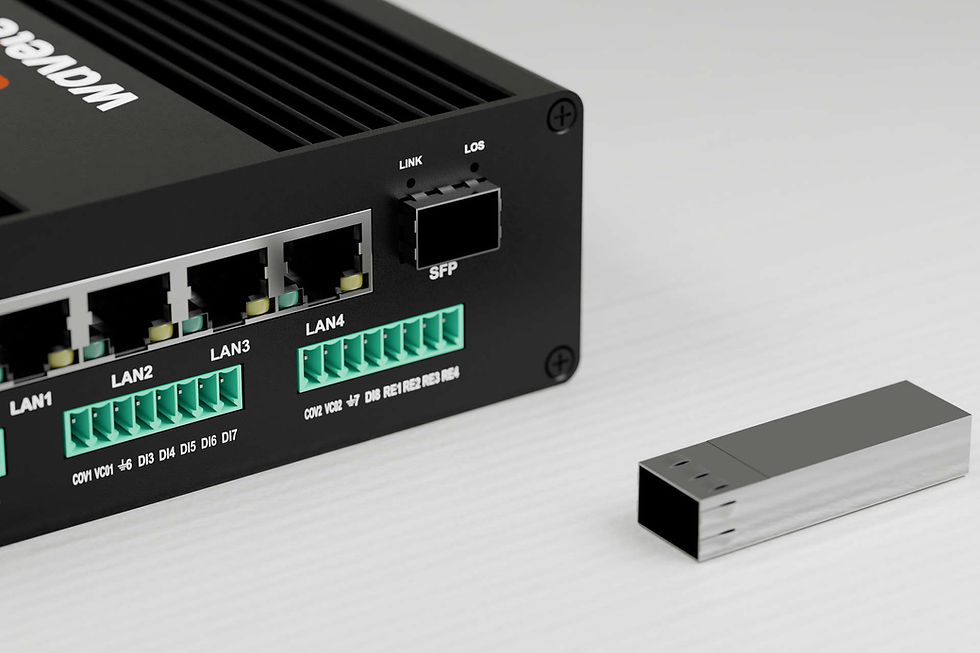
Two things follow from that. The link type can be chosen to suit the site, and it can change later without replacing the router. The trade-off is that compatibility now depends on the module as well as the router, so speed, fiber type and distance all need checking.
Why fiber still shows up on industrial sites
Fiber is common where copper becomes awkward: long runs between buildings or cabinets, a site backbone that was built on fiber, or surroundings where operators prefer optical links. This is general industry practice, so the first job is simply to find out what your site has.
If it does have fiber, a router with only copper ports usually needs a media converter or switch between the fiber and the router. That is one more device to buy, power, mount and monitor.
When an SFP port makes a difference
The situations below are hypothetical examples to help you test your own site against them. They are not Wavetel case studies.
When the site already runs on fiber. Imagine a facility whose network room connects to its remote cabinets over fiber. A router with an SFP slot can join that network directly, provided a compatible module is available.
When equipment sits far from the network room. Imagine a pump station or a yard cabinet some distance from the main building. Fiber may be the practical way to bring the local network out to it, while cellular gives the router a separate path for remote access.
When one cabinet has to cover several interfaces. Imagine a cabinet with a PLC on Ethernet, a sensor on RS-485, door contacts on digital inputs and a fiber link back to the site network. The question is whether one router offers all of those interfaces, and it is easy to miss on a spec sheet.
When copper is enough. Not every site needs fiber. If the cabinet is a short run from the switch and the site is cabled in copper, a 2.5GE or GE port may do the job, and an SFP slot is simply flexibility held in reserve.
Five questions to ask before you choose
What does the site actually have? Fiber type, connector type and where the fiber terminates.
What link speed do you need, and which module delivers it?
What role will the port play? A connection to the local network, or a WAN link? Routers differ, so check how the vendor describes it.
Is the module supported? Look for the vendor's guidance on SFP modules before you order.
How will you manage the router once it is installed? Remote access matters most at distant sites, so check the VPN and management options too.
Where the WR677-D fits
Wavetel lists the WR677-D with one SFP port alongside one 2.5GE port, four GE ports and Wi-Fi 6 AX3000. The product page FAQ groups the SFP port with the router's local-network interfaces and advises confirming the SFP module and link requirements during deployment planning.
The materials do not state the supported module types, link speed, fiber type or reach, or whether the port can act as a WAN interface. Treat those as questions for Wavetel before you design around the port.
Around that interface set, the WR677-D has two 5G modems that support active-active operation with four SIM slots, failover between Ethernet WAN and cellular WAN, serial and I/O interfaces, VPN support and remote-management options. Which of these matter depends on the site. The SFP slot is the part that connects to fiber.
FAQ
What is an SFP port on a router?
It is a slot for a pluggable transceiver module. The module you choose decides the physical link, such as optical fiber.
Does the Wavetel WR677-D have an SFP port?
Yes. The datasheet lists 1×SFP among the key features, and the product page FAQ lists one SFP port alongside one 2.5GE port, four GE ports and Wi-Fi 6 AX3000.
Can I connect fiber to the WR677-D?
An SFP slot can take a fiber module in general terms, but Wavetel's materials do not state supported module types, link speed, fiber type or reach. The product page advises confirming the SFP module and link requirements during deployment planning, so check with Wavetel before ordering modules.
Can the SFP port be used as a WAN connection?
The materials do not say. The product page describes the SFP port among the local-network interfaces. The router does support failover between Ethernet WAN and cellular WAN, so confirm with Wavetel whether the SFP port can serve as the WAN side in your design.
Do I need the SFP port if copper is enough?
Not necessarily. The WR677-D also has one 2.5GE port and four GE ports. The SFP slot matters mainly when the site's cabling is fiber.
Where do I get the datasheet or ask a technical question?
Use the datasheet and Technical Support links under Official resources below.
Official resources
External references
INF-8074i: SFP (Small Formfactor Pluggable) Transceiver, SFF Committee (SNIA): the multi-source agreement behind the SFP form factor.
IEEE 802.3 Standard for Ethernet, IEEE Standards Association: the Ethernet standard, which covers operation over copper and optical fiber.
Guide to Fiber Optics, Fiber Optic Association: an introduction to singlemode and multimode fiber.
A note on sources: statements about the WR677-D come from the Wavetel datasheet (v2.0) and product page. General explanations of SFP and fiber are standard networking background, not Wavetel claims.

