
In-Depth Analysis of 5G Industrial Routers: How Industrial CPE Empowers the New Era of Everything Connected
Table of Contents
What Are Industrial CPE and 5G Industrial CPE?
Core Technical Features of 5G Industrial Routers
Typical Application Scenarios of 5G Industrial Routers
How to Choose the Right 5G Industrial CPE?
Conclusion: Choosing 5G Industrial CPE Means Choosing the Future
Introduction: From Connectivity to Intelligence — A Profound Transformation of Industrial Communications
As manufacturing enters the deep waters of Industry 4.0, as the capillaries of smart cities extend to every corner, and as critical infrastructure in energy, transportation, and logistics places unprecedented demands on data transmission, traditional wired networks and consumer-grade wireless devices can no longer shoulder this mission. Against this backdrop, 5G Industrial Routers and Industrial CPE, serving as the neural hub of the Industrial Internet of Things (IIoT), are reshaping the way every industry connects—with outstanding performance, exceptional reliability, and flexible deployment capabilities.
From PLC-driven assembly lines to smart grid electricity meters; from CCTV security perimeters to ATMs in remote areas; from relay-controlled automation equipment to solar inverter stations—5G industrial routers are becoming the intelligent connectivity hub of these critical infrastructures. This article provides an in-depth interpretation of this key device that empowers industrial digital transformation, covering technical principles, core differences, key features, typical applications, and selection strategies.

1. What Are Industrial CPE and 5G Industrial CPE?
1.1 Basic Concept and Evolution of CPE
CPE (Customer-Premises Equipment) is the "translator" that connects carrier networks to user-side devices. Its core function is to convert mobile communication signals (2G/3G/4G/5G) or fixed broadband signals into local LAN signals (Ethernet or Wi-Fi) for user devices.
From a technology-evolution perspective, CPE has leapt from data terminals in the 2G/3G era, to high-speed gateways in the 4G LTE era, and now to intelligent access devices in the 5G era. Industrial CPE is the specialized form of CPE for the industrial sector—it not only inherits the connectivity functions of general-purpose CPE but also features industrial-grade reliability, durability, and protocol compatibility.

1.2 Core Definition of 5G Industrial CPE
A 5G Industrial CPE is a "three-in-one" intelligent terminal that integrates a 5G cellular communication module, a Wi-Fi router, and an industrial gateway. It has the following core characteristics:
Powerful compute: Industrial-grade multi-core ARM processors supporting data forwarding, protocol handling, and device management
High-speed connectivity: Supports 5G Sub-6GHz and millimeter wave (mmWave), with downlink speeds reaching several Gbps
Ultra-low latency: End-to-end latency as low as 1 ms, meeting the real-time control needs of industrial automation
Edge computing capability: Performs local data preprocessing, filtering, and analysis, relieving cloud pressure
Multi-protocol convergence: Native support for industrial protocols such as Modbus, MQTT, OPC UA, CAN, and DNP
Adaptation to harsh environments: Operating temperatures typically covering -40°C to +75°C, with IP protection ratings

1.3 Essential Differences Between Industrial CPE and Consumer CPE
Many people confuse industrial CPE with consumer CPE, but the two differ fundamentally across several dimensions. Consumer CPE prioritizes ease of use and aesthetic design, while industrial CPE pursues "never-down" reliability. Specifically: at the hardware level, industrial CPE uses industrial-grade components with wide-temperature design; at the software level, it supports a rich set of VPN protocols (PPTP, L2TP, IPSec, GRE, OpenVPN, WireGuard) and dynamic routing protocols (BGP, OSPF, RIP, VRRP); at the management level, it supports remote management methods such as TR069, SNMP, SMS, and RMS; and at the interface level, it provides rich I/O capabilities including RS232, RS485, DI/DO, AI, and RELAY.

For a detailed architecture of industrial router hardware, Wavetel IoT has published an in-depth technical guide covering CPU, memory, cellular module, SIM/eSIM, serial ports, Ethernet, Wi-Fi protocols, and more—interested readers can refer to The Ultimate Guide to Industrial Router Hardware. In addition, enclosure selection for industrial routers (IP67 rating, DIN-rail mounting, etc.) is critical to stability in harsh environments; see How to Choose an Industrial Router Enclosure — A Comprehensive Guide.
2. Core Technical Features of 5G Industrial Routers
2.1 Dual-Mode 5G SA/NSA: Flexibly Adapting to Network Evolution
Current 5G network deployments come in two modes: Standalone (SA) and Non-Standalone (NSA). An excellent 5G industrial router must support both modes to adapt to the deployment stage of networks in different countries and regions.
NSA mode: Relies on the existing 4G core network, with fast and low-cost deployment, suitable for regions where 5G coverage is not yet complete.
SA mode: Based on an independent 5G core network, it fully leverages 5G features such as network slicing and ultra-low latency, making it suitable for scenarios with extremely high network performance requirements such as smart manufacturing and autonomous driving.

Wavetel IoT's flagship 5G industrial router products, such as the WR574 5G Industrial Router and WR575 5G Industrial Router, comply with the 3GPP Rel-16 standard and fully support both NSA and SA modes in Sub-6GHz.
2.2 5G RedCap: Tailor-Made for Mid-Speed Scenarios
5G RedCap (Reduced Capability), introduced as an important feature of 3GPP Rel-17, is becoming a favorite in the industrial IoT sector. RedCap is not a "cut-down" version of 5G, but rather a standard specifically designed for mid-speed industrial devices. It delivers "just-right" performance—150 Mbps downlink and 10–20 ms latency—at a fraction of the cost of full 5G. As 4G gradually reaches its performance ceiling while full 5G remains too expensive for mass deployment, RedCap becomes the economic and technological "sweet spot" for the next generation of industrial connectivity. For an in-depth discussion of RedCap, see 5G RedCap, Lightweight 5G and Industrial IoT.
Wavetel IoT has taken a forward-looking approach in launching the WR153 5G RedCap Industrial Router and WR254 5G RedCap Industrial Router. These two products comply with the 3GPP Rel-17 RedCap standard while remaining compatible with 5G SA and 4G LTE networks, offering highly cost-effective choices for M2M and IoT applications.
2.3 Dual SIM and Dual-Module Redundancy: Delivering Enterprise-Grade Reliability
For "zero-interruption" scenarios such as finance, healthcare, and critical production lines, a single network link can no longer meet requirements. Dual-SIM and dual-cellular-module designs have become standard on high-end 5G industrial routers.
Take the WR677-D Dual 5G Cellular Industrial Router as an example: it features two independent 5G modules operating in Active-Active mode. The two modules can accept SIM cards from different carriers, achieving true carrier-grade redundancy—even if one carrier experiences a regional outage, business continues without interruption. Additionally, dual-link aggregation can stack bandwidth, further improving availability at critical sites.
The WR677-M 5G+4G Dual Cellular Industrial Router uses a 5G+4G hybrid dual-mode design. In regions where 5G coverage is not yet stable, 4G can serve as a reliable backup, balancing performance and reliability. In addition to cellular-side redundancy, excellent 5G industrial routers also support automatic switching between Ethernet WAN and cellular WAN (WAN Failover)—when the primary link fails, the device automatically switches to the cellular link. This mechanism is particularly important for branch offices, retail stores, and medical clinics.

2.4 Edge Computing and Multi-Protocol Support
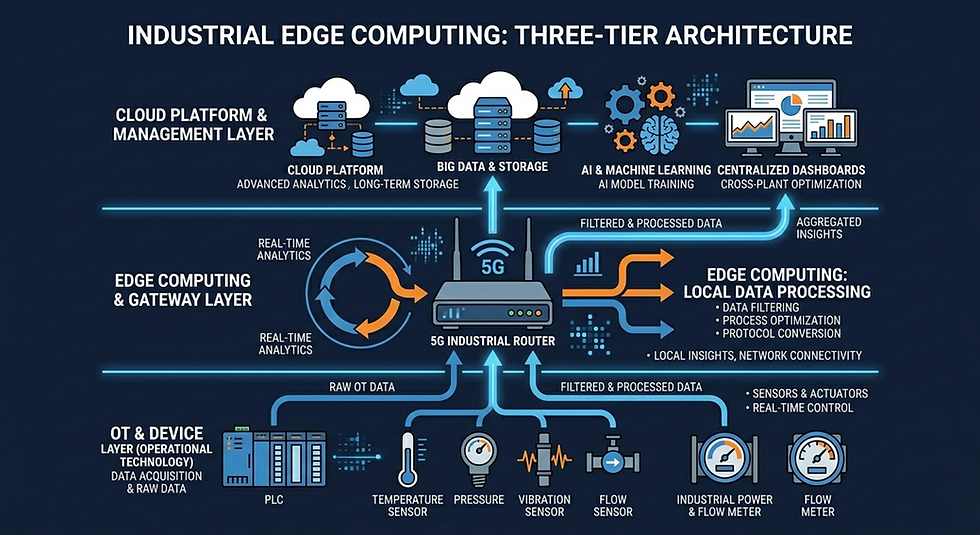
Modern 5G industrial routers are not just "pipes"—they are intelligent nodes with edge-computing capability. They natively support mainstream industrial protocols such as Modbus (TCP/RTU) and MQTT, can directly collect data from PLCs, sensors, and instruments, perform initial processing locally, and then upload to the cloud. This architecture significantly reduces cloud compute load and network bandwidth usage while improving system real-time responsiveness.
2.5 Full-Stack Security and Industrial-Grade Reliability Design
In the Industry 4.0 era, network security has extended from the software layer into the physical hardware layer. Modern 5G industrial routers build a multi-layered security and reliability system: VPN tunnel encryption supports multiple protocols including PPTP, L2TP, IPSec, GRE, OpenVPN, and WireGuard; fine-grained firewall policies enable access control; and the TPM 2.0 Trusted Platform Module serves as a "hardware trust anchor" providing end-to-end trustworthy assurance.
Furthermore, when industrial routers operate at unmanned remote sites, any program hang can cause business interruption. The Watchdog Timer (WDT) is designed to solve exactly this problem—it automatically triggers a restart when the system is abnormal, ensuring the device returns to normal operation. High-end industrial routers typically feature multi-level watchdogs: a software watchdog that monitors applications; a hardware watchdog that runs independently of the CPU; and a network watchdog that monitors link status. For a detailed analysis of watchdog mechanisms, see How Does a Watchdog Timer (WDT) Work in an Industrial Router/IoT Gateway.

2.6 WRTOS: An Operating System Built Specifically for Industrial Use
The core competitiveness of an industrial router lies not only in hardware, but also in its operating system. Wavetel IoT's self-developed WRTOS (Wavetel Router Operating System) is a highly optimized Linux-based embedded operating system designed specifically for the demanding needs of industrial IoT.
Unlike consumer-grade software, WRTOS puts stability and security first through modular design, dual hardware/software watchdogs, and comprehensive multi-link redundancy. It natively supports 10 VPN protocols, as well as industrial standards such as Modbus and MQTT, effectively bridging the gap between field-layer OT data and IT cloud platforms.
3. Typical Application Scenarios of 5G Industrial Routers

3.1 Smart Manufacturing and Industry 4.0
In modern smart factories, every PLC, every sensor, and every AGV on the production line requires a stable, low-latency network connection. Traditional wired networks struggle with frequently adjusted flexible production lines, while 5G industrial routers provide an ideal solution for smart manufacturing.
According to the Wavetel 5G Router WR575 in Smart Factory Automation case study, typical deployment includes the following steps: deploying WR575 routers across production lines, connecting various devices via Ethernet, Wi-Fi, and serial ports; configuring multi-VLAN to isolate traffic across MES, quality inspection, logistics, and other business functions; enabling 5G dual-SIM for automatic failover when the primary network fails; and integrating with cloud platforms for remote monitoring and predictive maintenance. This solution has been widely validated in automotive, electronics, and heavy industry sectors. For more industrial-sector solutions, see Wavetel IoT Industrial Industry Solutions.

3.2 Smart Cities and Video Surveillance
HD video surveillance places extremely high demands on bandwidth, and urban surveillance points are often widely distributed, making wired deployment prohibitively expensive. With high bandwidth, low latency, and flexible deployment, 5G industrial routers are an ideal choice for smart-city video surveillance. The WR574 5G Router provides ultra-low-latency wireless connectivity for real-time HD video transmission in urban environments, effectively supporting public safety, traffic management, and similar use cases. For detailed solutions, visit Smart City Industry Solutions.

3.3 Smart Grids and Energy Management
The power industry places extremely high reliability requirements on communication equipment—whether for substation monitoring, smart meter data collection, or distributed energy management, communication devices that can operate stably in harsh electromagnetic environments are essential. Industrial 4G/5G routers support remote monitoring of power substations and grid equipment, enabling fault detection in harsh environments and reducing downtime. For solar power stations, industrial IoT gateways can transmit real-time data via 4G/LTE to cloud platforms, optimizing solar-farm management efficiency. For more energy-sector solutions, visit Energy & Utilities Industry Solutions.

3.4 Smart Logistics and Transportation
Digital transformation in the logistics industry depends on stable wireless connectivity. Industrial cellular routers provide real-time tracking and monitoring capabilities for logistics vehicles, warehousing, cold-chain transportation, and more, significantly improving logistics efficiency and safety. Wavetel IoT offers vehicle-grade products and complete solutions for the Transportation industry, supporting key features such as GNSS positioning, ignition detection, and anti-vibration.
3.5 Finance, Retail, and Enterprise Branches
For financial and retail devices such as ATMs, POS terminals, and self-service vending machines, the security and continuity of the network directly affect transaction success rates. Industrial cellular routers provide secure and reliable primary/backup connections for ATM transactions, ensuring uninterrupted service and supporting real-time remote monitoring.
In addition, the Wavetel WR677 5G Router provides a plug-and-play connectivity solution for pop-up stores, supporting secure payments and cloud access while dramatically reducing deployment time and operational costs. It is also an ideal choice for small and medium-sized enterprises (SME/SMB).
At the enterprise network level, MPLS leased lines have long been the mainstream choice for enterprise WANs, but they suffer from long deployment cycles (4–8 weeks), high cost, and poor flexibility. According to 5G Industrial Routers Empowering Enterprise Networks: Architecture, Scenarios and Best Practices, the average 5G Sub-6GHz downlink speed has reached several hundred Mbps with latency in the 10–30 ms range, so cellular links have been upgraded from "backup" to a viable "primary link" option. The plug-in-SIM-and-go nature of 5G industrial routers compresses remote-site network deployment time from weeks to minutes. For more scenarios, visit Enterprise Industry Solutions and Retail Industry Solutions.
3.6 Smart Elevators and Remote Monitoring
As a critical facility for vertical transportation, safety monitoring and emergency communication for elevators are paramount. According to the 4G Industrial Router for Smart Elevator Monitoring and Safety case study, by installing an industrial router in the elevator control cabinet, connecting sensors for vibration, door status, and speed, and connecting cameras and emergency phones via Ethernet/Wi-Fi, real-time remote monitoring, emergency communication, and predictive maintenance can be achieved.
For municipal infrastructure such as water, gas, and heating, as well as industrial scenarios such as oil and gas pipelines and remote pump stations, SCADA systems require reliable communication links. As SCADA evolves from isolated architectures to open IIoT environments, industrial routers—through secure 4G/5G VPN tunnels—have become a critical bridge connecting remote RTUs/PLCs to central control centers. For detailed solutions, see Applications of Industrial Routers in SCADA Systems.
4. How to Choose the Right 5G Industrial CPE?
Faced with a dazzling array of products on the market, how do you choose the 5G industrial router that best fits your business? Several dimensions deserve careful consideration.
4.1 Selection by Network Requirements
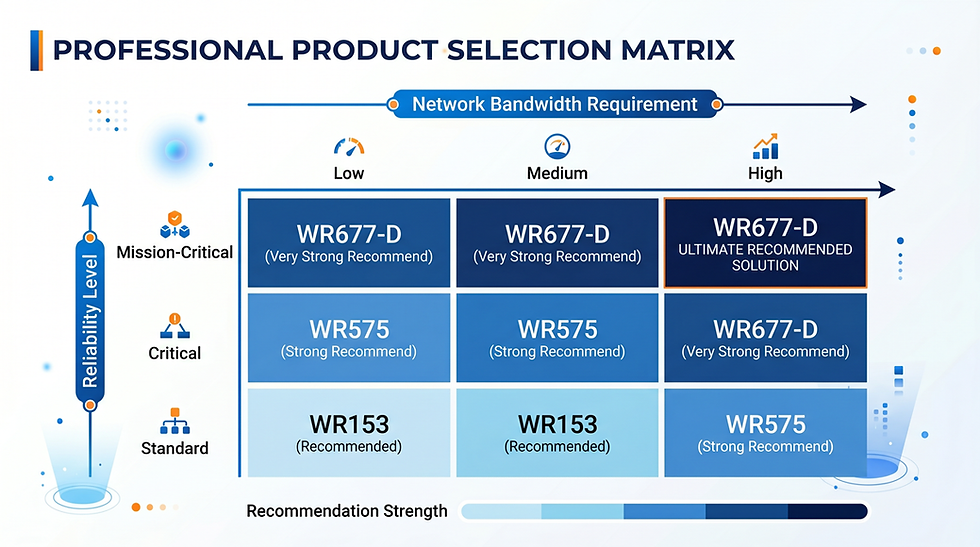
High-performance 5G flagship models: If your business has extremely high requirements for bandwidth and latency (such as video surveillance, real-time control, high-density IoT), prioritize high-end models that support 5G Sub-6GHz NSA & SA, such as the WR575, WR574, and the flagship WR677-D dual-5G product.
5G RedCap mid-speed models: For mid-speed scenarios where cost matters (such as industrial sensors, POS, smart meters, general surveillance), the WR153 and WR254 RedCap products balance performance and price.
4G LTE economy models: For those not in a rush to upgrade to 5G, or deployments where 4G coverage is already sufficient, the WR245 LTE Cat 4 Industrial Router, WR143, and other 4G products provide stable, reliable choices.
4.2 Selection by Reliability Level
General business: Single 5G or single 4G + WAN Failover is sufficient. Critical business: Choose models with dual-SIM and dual modules, such as the WR677-D or WR677-M. Extremely critical business: Finance, healthcare, critical production lines—must choose the dual-5G dual-module Active-Active WR677-D, and it is strongly recommended to use two SIMs from different carriers for true carrier-grade redundancy.
4.3 Selection by Interface and Environmental Conditions
Choose based on the interface types and quantities required by the deployment scenario: Ethernet ports (2/4/5 GE/FE ports, some supporting 2.5 GE), Wi-Fi (Wi-Fi 4/5/6/7), serial ports (RS232/RS485), I/O interfaces (DI/DO/AI/RELAY), PoE (Active PoE In/Out, Passive PoE In), SFP fiber interfaces, and optional features such as GNSS and Bluetooth.
Different deployment environments also place significantly different demands on devices: ordinary indoor environments can use general industrial-grade equipment; factory floors require wide-temperature operation (-40°C to +75°C) and electromagnetic-interference resistance; harsh outdoor environments require IP protection ratings, lightning-protection design, and wide-voltage input; mobile scenarios (vehicle, marine) require anti-vibration, ignition detection (Ignition), and GNSS positioning. You can visit the Wavetel IoT Router Product Catalog and use its multi-dimensional filtering to quickly locate the model that best fits your needs.
5. Wavetel IoT — Your Trusted 5G Industrial CPE Partner
Wavetel IoT is a company focused on innovation in IoT terminal devices. Its core team consists of senior experts with years of deep experience in the IoT field. Our mission is to provide the best user experience for customers in energy, security, automotive, environmental, and smart manufacturing industries through outstanding product design and one-stop IoT solutions.
Complete Product Matrix: Wavetel IoT offers a complete 5G/4G industrial router product line from entry-level to flagship, including flagship dual-5G (WR677-D, WR677-M), mainstream 5G (WR575, WR574, WR578, WR777), 5G RedCap (WR153, WR254), LTE Cat 6 (WR565), and LTE Cat 4 (WR245, WR143). In addition to routers, we also offer a rich range of Accessories to provide supporting components for overall solutions.
Full Enterprise-Grade Feature Coverage: All products support 3GPP Rel-16/17 standards, NSA & SA dual mode, rich VPN protocols, dynamic routing, industrial protocols, and multiple management methods, and run our self-developed WRTOS operating system.
Deep Industry Application Experience: Wavetel IoT's products have been successfully deployed in a wide range of industrial M2M scenarios, including PLC-driven assembly lines, warehouses covered by industrial APs, smart-grid electricity meters, CCTV security, and remote ATMs.
Customization Capabilities: In addition to standard products, Wavetel IoT offers powerful Customization Services. From hardware and software development, prototyping, functional and environmental testing, on-demand mass production, to product delivery and ongoing support, we can tailor optimized products to the specific application scenarios of our customers.
Strict Quality Standards: Wavetel IoT implements a rigorous ISO-certified quality management system, fully complying with regional industry regulations and safety standards, ensuring that every device meets the highest international safety and performance benchmarks.
All-Round Support and Purchasing Channels: Customers can access the resources they need through the Technical Support, Warranty Info, How to Buy, and Become a Distributor pages; the Guide Videos and Documents Download pages provide a rich set of learning materials for engineers. For customers with fast procurement needs, Wavetel IoT also operates an Online Store, providing a convenient purchasing channel. To learn more, visit About Wavetel IoT and News & Industry Insights.
6. FAQ
Q1: What is the difference between Industrial CPE and 5G Industrial CPE?
Industrial CPE is a broad concept referring to customer-premises equipment capable of working in industrial environments; it can be based on any cellular network such as 2G/3G/4G/5G. 5G Industrial CPE specifically refers to industrial CPE based on 5G networks. In addition to all the features of traditional industrial CPE, it offers Gbps-level bandwidth, millisecond-level latency, network slicing, and other capabilities unique to 5G, making it especially suitable for scenarios with extremely high network-performance requirements such as video surveillance, real-time control, and high-density IoT.
Q2: Are 5G industrial routers and 5G Industrial CPE the same thing?
The two overlap significantly in function, but their emphasis is slightly different. 5G industrial routers emphasize network-layer functions such as routing/forwarding, VPN, and firewall; 5G Industrial CPE emphasizes signal conversion and terminal-access capabilities. In the current market, the vast majority of 5G industrial router products (such as Wavetel's WR574, WR575, and WR677 series) have all the functions of both, so the two terms are often used interchangeably.
Q3: In which scenarios should 5G RedCap be chosen over full 5G?
5G RedCap is suitable for the following scenarios: downlink speed requirements below 150 Mbps (such as industrial sensors, POS machines, smart meters, general surveillance cameras); large-scale deployments that are cost-sensitive; and scenarios with certain power-consumption requirements. Full 5G is suitable for scenarios with large bandwidth needs such as video-surveillance backhaul, real-time control, and high-density AP coverage. Wavetel's WR153 and WR254 are typical RedCap models.
Q4: Why does industrial CPE require such a wide operating temperature range?
Industrial CPE is often deployed in non-air-conditioned control cabinets, outdoor electrical boxes, in-vehicle environments, substations, and other locations, where ambient temperatures may range from -40°C in northern winters to +75°C inside sun-baked equipment boxes. Wide-temperature design (typically -40°C to +75°C) ensures the equipment still works stably in these harsh environments—something consumer-grade equipment simply cannot withstand.
Q5: Why do 5G industrial routers need dual SIMs or even dual modules?
A single-SIM, single-module configuration has single-point-of-failure risk—once the SIM fails, the carrier signal drops, or the module has a hardware issue, the entire business link goes down. Dual SIM can automatically switch to the other card when one has a problem; dual modules (such as the WR677-D) can keep both links active simultaneously (Active-Active), so a single link failure results in completely imperceptible switchover—a must-have for zero-interruption scenarios in finance, healthcare, and critical production lines.
Q6: Can 5G industrial routers replace MPLS leased lines as the enterprise primary link?
In most scenarios, yes. The average downlink speed of 5G Sub-6GHz can reach several hundred Mbps with 10–30 ms latency—enough to smoothly support video conferencing, cloud desktops, ERP, and other mainstream enterprise applications. For branch offices, retail chains, and temporary sites, the combination of 5G as primary link + wired backup (or dual 5G) offers better cost-effectiveness and deployment flexibility than MPLS. For detailed analysis, see 5G Industrial Routers Empowering Enterprise Networks: Architecture, Scenarios and Best Practices.
Q7: Which mainstream industrial protocols does 5G Industrial CPE support?
An excellent 5G Industrial CPE should natively support mainstream industrial protocols such as Modbus (TCP/RTU) and MQTT, enabling it to interface directly with PLCs, instruments, sensors, and other OT devices, and upload the converted data to cloud IT systems. Wavetel's entire product line is built on the WRTOS operating system, with full support for industrial and VPN protocols.
Q8: How do 5G industrial routers ensure network security?
Modern 5G industrial routers adopt a multi-layered security architecture: at the transport layer, VPN protocols such as IPSec, OpenVPN, and WireGuard encrypt data; at the application layer, fine-grained firewall policies control access; at the hardware layer, an optional TPM 2.0 Trusted Platform Module provides a hardware-level root of trust; and at the management layer, secure management protocols such as HTTPS, SSH, and SNMPv3 are supported—comprehensively safeguarding the data security of the industrial network.
Q9: How important is the watchdog mechanism for industrial deployment?
For unmanned remote sites (such as remote oil wells, mountain surveillance points, and offshore platforms), the watchdog mechanism is practically a must-have. Without a watchdog, a single program hang could cause days of business interruption and costly manual on-site maintenance. A multi-level watchdog (software + hardware + network) can raise the device's "unmanned availability" above 99.9%. For a detailed explanation of the mechanism, see How a Watchdog Timer Works.
Q10: How do I determine the IP protection rating my application needs?
The general rule: for deployment inside indoor control cabinets, IP30–IP40 is sufficient; factory floors may have dust and oil, and IP54 or higher is recommended; outdoor deployment without shelter (such as light poles, open fields) requires IP65 or higher; underwater or strongly humid environments (such as chemical plants, maritime) require IP67 or even IP68. For a detailed guide on protection ratings, see How to Choose an Industrial Router Enclosure.
Q11: Do Wavetel IoT products support bulk remote management?
Absolutely. All Wavetel IoT industrial routers support multiple remote management methods including TR069, SNMP, SMS, and RMS, enabling zero-touch configuration, remote upgrades, status monitoring, and fault alerts at scale through a cloud management platform, dramatically reducing O&M costs for large-scale deployments.
Q12: How do I purchase Wavetel IoT 5G Industrial CPE products?
There are two convenient avenues: for project procurement or large-batch needs, connect with our sales engineers through the Contact Us page to get customized quotes and technical consultation; for small-batch or sample purchases, place orders directly through the Wavetel Online Store, which supports fast shipping. Customers interested in becoming regional partners can also check the Become a Distributor page for details on our partnership program.
7. Conclusion: Choosing 5G Industrial CPE Means Choosing the Future
From industrial CPE to 5G Industrial CPE, from single connectivity to intelligent edge—the evolution of this device category is a microcosm of industrial digital transformation. Looking ahead, as 5G-Advanced (5G-A) is commercialized, high-end CPE downlink speeds will approach 7 Gbps; AI models will be deployed directly on edge devices, enabling millisecond-level local decisions; and green low-power design and 5G network-slicing capabilities will open up even more possibilities for the next generation of industrial CPE.
In this era where data is productivity, choosing the right 5G industrial router means injecting future-ready connectivity into your business. Whether you are planning the network architecture of a smart factory, looking for a smart-city communication solution, an enterprise IT manager hoping to upgrade branch networks, or an integrator designing IoT solutions for customers—Wavetel IoT can provide all-round support, from products to solutions.
We cordially invite you to visit the Wavetel IoT Official Website to learn more about our products, or contact our engineering representatives. We will respond to your inquiry within 24 hours and tailor the most suitable 5G Industrial CPE solution for you.


Comments