
Satellite Communication + 5G Industrial Router Convergence Solution
Updated: Aug 27
— A Typical Case Study: Starlink + Peplink
Table of Contents
Why a Single Connectivity Method Is Not Enough
The Value of Satellite + 5G Converged Communication
Typical Solution Architecture (Starlink + Industrial Router)
Analysis of Wavetel Industrial Router Capabilities
Core Technology Analysis
Typical Application Scenarios
1. Introduction
One of the core propositions of industrial digital transformation is the reliability of network connectivity. From SCADA remote monitoring in traditional manufacturing to unmanned mines, smart ports, and offshore wind power, industrial sites are becoming increasingly dependent on networks at an unprecedented pace. Any interruption in connectivity can cause data loss, production stoppages, equipment failures, and even safety incidents.
However, the geographic distribution of real industrial scenarios is far more complex than urban internet environments. Oil and gas wellsites are deep in desert hinterlands, mines are nestled in rugged mountains, offshore platforms are hundreds of kilometers from the mainland, and ground infrastructure at emergency rescue sites may be completely paralyzed. In such scenarios, no single connectivity method can independently bear the responsibility of being "always online."
It is against this backdrop that converged communication solutions centered on Starlink's Low Earth Orbit (LEO) satellite internet and 5G industrial routers are rapidly becoming the preferred path for industrial enterprises to build highly resilient network architectures. Starlink breaks through the geographic boundaries of cellular networks; 5G/4G industrial routers provide low-latency, high-bandwidth access in areas with coverage; and intelligent multi-WAN routing and link aggregation technologies seamlessly integrate both into a unified network infrastructure. This article systematically reviews the technical logic, architecture design, core capabilities, and industry implementation practices of this converged solution.

2. Why a Single Connectivity Method Is Not Enough
2.1 Limitations of Satellite Communication
LEO satellite systems such as Starlink have unparalleled advantages in coverage, but when used alone as an industrial connectivity solution, several limitations cannot be ignored.
Risk of brief interruptions. Starlink satellites fly at approximately 550 km altitude at high speed, and user terminals must continuously switch between different satellite nodes, with each handover typically within 1 second. However, for industrial SCADA systems, real-time video streams, and VPN tunnels, even hundreds of milliseconds of interruption can trigger application-layer timeout reconnections, causing production system alerts or even misoperations.
Weather impact. Extreme weather such as heavy rain and snow causes "rain fade" on Ku/Ka frequency bands, leading to reduced throughput or even brief outages — particularly prominent in tropical monsoon regions and high-latitude areas.
Security capabilities rely on external supplementation. Starlink itself does not provide end-to-end encryption or industrial-grade security protocols. Its stock router lacks enterprise-grade security features such as VPN encryption, firewalls, and access control. Production data and control commands transmitted from industrial sites over public networks face risks of leakage and attack, requiring additional security equipment to compensate.
Absolute lower limit on latency. Although LEO satellite latency is better than traditional GEO satellites (reduced from 600ms+ to 20–60ms), it still lags behind 5G cellular (1–10ms). For scenarios requiring highly deterministic latency, such as precise industrial robot control and PLC real-time command delivery, pure satellite solutions cannot meet requirements.

2.2 Limitations of 5G/4G Networks
5G represents the highest level of terrestrial wireless communication in technical specifications, but it also faces unavoidable constraints in industrial deployments.
Coverage blind spots are the fundamental bottleneck. Global 5G infrastructure is highly concentrated in cities and industrial parks. A large number of industrial scenarios — offshore platforms, desert oilfields, highland mines, deep mountain forest areas — are still in coverage vacuums. Less than 20% of the world's land area has 5G signal coverage, and cellular coverage of ocean surfaces is nearly zero. This issue cannot be fully resolved through infrastructure construction in the short term.
Single-operator dependency creates single-point risk. Using a single SIM card means that once that operator's base station loses power, fiber is cut, or a systemic failure occurs, field devices are completely disconnected. Pure cellular solutions without redundancy are extremely risky in industrial scenarios.
Environmental factors affect signal quality. Even within theoretical coverage areas, terrain obstructions, building penetration loss (steel-framed factories, underground warehouses), and network congestion create a significant gap between actual experience and stated specifications.
2.3 Higher Network Requirements in Industrial Scenarios
The fault tolerance of industrial networks is far smaller than that of consumer internet. Industry 4.0 standards require core production system network availability of 99.99% (no more than 52 minutes of annual downtime); industrial control systems require "deterministic" latency rather than "average" values — sudden latency spikes are more destructive than consistently high latency; field devices widely use industrial protocols such as Modbus, DNP3, and IEC 61850, requiring network equipment that can understand and process them rather than acting merely as a transparent IP pipe; IT/OT traffic security isolation is a fundamental principle of industrial network security, which must be ensured through VPN encryption and access control.
These requirements collectively point to the same conclusion: industrial networks must establish a converged communication architecture with multi-link redundancy, intelligent switching, and manageable security.
Further reading: Industrial IoT Ecosystem: A Comprehensive Analysis of Modules, Gateways, Switches, and Routers
3. The Value of Satellite + 5G Converged Communication
3.1 Advantages of the Converged Architecture
The convergence of satellite and 5G is not a simple technical overlay, but a systemic value created from complementary characteristics.
Complementary coverage, eliminating blind spots. 5G delivers optimal performance in areas with infrastructure, while Starlink seamlessly fills in beyond the coverage boundary. Together, no matter where industrial equipment is deployed, at least one available link always exists.
Complementary performance, leveraging strengths. Latency-sensitive control commands and video conferencing are prioritized on the 5G low-latency channel; high-bandwidth but latency-insensitive tasks (video recording uploads, firmware upgrades, database backups) use the Starlink high-bandwidth channel, maximizing overall network efficiency.
Stacked reliability, eliminating single points of failure. If either link fails, the other automatically takes over, raising network availability from single-link 99.5%–99.9% to 99.99% or above.
Cost optimization, on-demand allocation. Through traffic policy control, satellite traffic is used only in "5G-unreachable" or "5G-failure" scenarios; daily business runs on cellular networks, significantly reducing overall operational costs.

3.2 Typical Modes of Starlink + Industrial Router
Mode 1: 5G as primary link + Starlink as hot standby. The most common deployment mode, suitable for industrial parks and peri-urban sites with 5G coverage. 5G carries all daily traffic; Starlink is in hot standby, and traffic automatically switches in seconds when link health detection fails, then automatically falls back upon recovery — achieving very high availability at low satellite traffic cost.
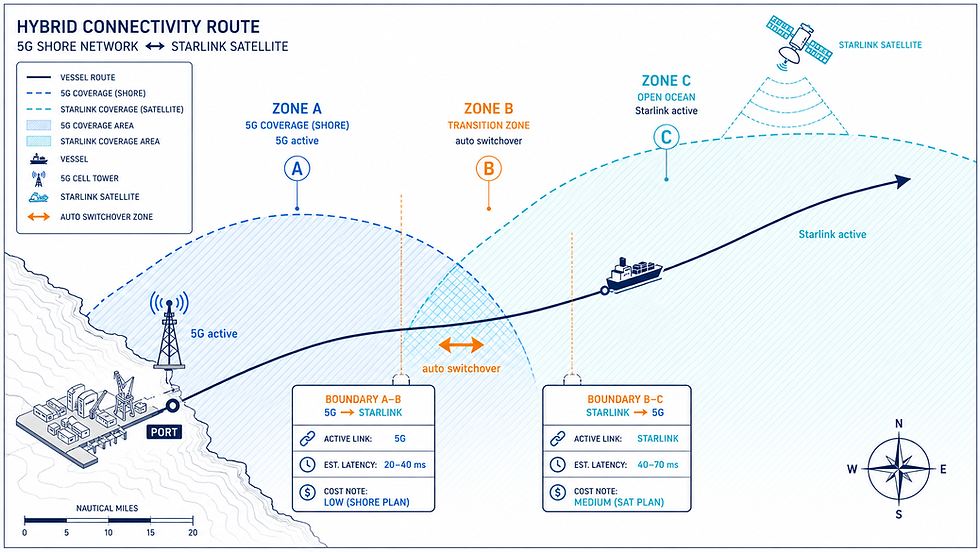
Mode 2: Starlink as primary link + 5G/4G supplement. Suitable for remote areas and offshore scenarios. Starlink serves as the backbone primary link; when devices enter a cellular coverage area (docking, entering town), 4G automatically activates to carry traffic and reduce satellite costs; when leaving the coverage area, satellite takes over again.
Mode 3: Dual-link load balancing. Suitable for scenarios where both links are stable and bandwidth demand is high (ocean-going vessels, large offshore platforms). Both links operate simultaneously; an intelligent weighted algorithm dynamically distributes traffic to achieve bandwidth aggregation while maintaining dual-link redundancy protection.
4. Typical Solution Architecture (Starlink + Industrial Router)
A complete converged solution is physically composed of four layers:
WAN Access Layer: Two independent uplinks coexist on the upstream side. The satellite link is provided by a Starlink dish antenna, with an RJ45 interface led out via an Ethernet adapter connected to the router's ETH WAN port; the cellular link is provided by the router's built-in 5G/4G module, supporting dual SIM cards from two operators. The two links are completely physically independent.
Industrial Router Core Layer: The router is the intelligent hub of the entire solution, responsible for multi-WAN management, routing policy enforcement, VPN encryption, protocol processing, and device management. It monitors the health of each WAN link in real time, executes switching and traffic allocation according to policies; implements IT/OT logical isolation through a firewall; and communicates directly with industrial control devices via Modbus/MQTT gateways, eliminating the need for additional protocol converters.
Field Access Layer: Multiple access methods are provided downstream — GE wired ports connecting SCADA servers and industrial PCs; Wi-Fi 6 coverage for mobile terminals; RS232/RS485 serial ports directly connecting PLCs, sensors, and DTUs; and I/O interfaces for receiving digital inputs and outputting control signals, covering all field device requirements.
Cloud Management Layer: Centralized, visualized O&M of dispersed devices is achieved through the RMS remote management system, supporting remote configuration delivery, firmware upgrades, alert notifications, and link status monitoring.
Key configuration detail: It is strongly recommended to set the antenna to "Bypass Router" mode (Bypass/IP Passthrough) in the Starlink App, allowing the industrial router to directly obtain a public IP address, completely eliminating double NAT issues and ensuring proper functioning of VPN passthrough, port mapping, SCADA remote access, and other features.

5. Analysis of Wavetel Industrial Router Capabilities
Wavetel IoT focuses on R&D of industrial IoT terminal devices. Its industrial cellular router series covers the full range from LTE Cat4 to dual 5G, natively supports Starlink satellite WAN access, and all models run the self-developed WRTOS industrial router operating system — making it an ideal industrial-side device for building satellite + 5G converged solutions.
5.1 5G High-Speed Access Capability
The flagship product WR677-D Dual 5G Industrial Router features two independent built-in 5G modules, both supporting 3GPP Rel-16 Sub-6GHz NSA/SA dual-mode, each capable of hosting a SIM card from a different operator — combined with a Starlink Ethernet WAN to form three completely independent uplinks. The 2.5GE high-speed WAN port fully matches the high throughput needs of the Starlink Business plan; 4×GE LAN ports and Wi-Fi 6 (AX1800 dual-band) provide gigabit-class access downstream.
The WR574 and WR575 are the main single-5G models, also supporting Wi-Fi 6, covering mid-to-high-end scenarios at higher cost-effectiveness. The WR153 uses 5G RedCap technology to achieve 100+ Mbps access at lower power consumption and cost, designed specifically for large-scale IoT terminals.
5.2 Industrial-Grade Networking and Protocol Support
All models support static routing, policy routing, and dynamic routing protocols (BGP, OSPF, RIP, NHRP, VRRP) to meet complex industrial network topology requirements. The built-in Modbus TCP/RTU gateway (Server/Client dual mode, supporting multiple data formats) can directly aggregate Modbus data from PLCs and sensors and forward it to cloud platforms without additional protocol converters. MQTT Broker/Client supports direct integration with AWS IoT, Azure IoT Hub, Alibaba Cloud IoT, and private platforms. Device management supports Web GUI, SSH, TR-069, SNMP, SMS, and RMS cloud management, adapting to enterprise-level NMS system integration requirements.
Further reading: Integration of Sensors, PLCs, and Modbus Gateways/Routers
5.3 High-Reliability Dual-Link Design
The WAN Failover mechanism is based on continuous link health detection (supporting Ping, HTTP GET, DNS Query, and other methods). After the primary link fails consecutive health checks, it automatically switches to the backup link, with support for automatic or manual fallback policies upon recovery. The WR677-M (5G+4G dual module) achieves triple switchover protection through its dual cellular module design, stacked with a satellite WAN.
At the hardware level, all models are designed to industrial wide-temperature standards (-40°C to +70°C), with DIN rail installation, wide-range DC input (9–36V), hardware watchdog (WDT) to prevent system deadlocks, and power reverse-polarity and ESD electrostatic protection ensuring long-term stable operation in harsh environments.
Further reading: Complete Guide to Industrial Router Hardware | How Watchdog Timers (WDT) Work in Industrial Routers
6. Core Technology Analysis
6.1 Multi-WAN and Link Switching
The router simultaneously manages an Ethernet WAN (connected to Starlink) and a cellular WAN (5G/4G), running independent health detection processes for each link — periodically sending ICMP Pings to reliable targets (e.g., 8.8.8.8). A detection interval of 5 seconds with 3 consecutive failures (i.e., 15 seconds) is recommended to trigger a switchover, balancing response speed and false-switchover protection.
Link switching migrates traffic at the network layer by modifying the default route's next hop. For long-lived TCP connection applications (Modbus TCP, SSH maintenance sessions), the application layer needs to rebuild connections after switching; combined with session persistence mechanisms at the VPN tunnel layer, the transparency of switchover to the application layer can be further enhanced.

6.2 Load Balancing
When both links are operating normally, Policy-Based Routing (PBR) distributes different types of traffic to the most suitable link: real-time control traffic with destination port 502 (Modbus TCP) is forced through the 5G low-latency link; high-volume video backhaul and firmware updates go through the Starlink high-bandwidth link; other traffic is dynamically allocated according to preset weights.
Dynamic weighted balancing automatically adjusts allocation weights based on real-time link quality (latency, packet loss rate, available bandwidth), suitable for scenarios where link quality changes dynamically over time (mobile vehicles, vessels). Session Persistence ensures that data packets for the same TCP connection always traverse the same link, avoiding packet reordering caused by multi-link transmission.

6.3 VPN and Data Security
Secure transmission of industrial data is non-negotiable. Wavetel IoT routers across the entire range support four mainstream VPN protocols: IPSec (IKEv1/IKEv2), L2TP, OpenVPN, and WireGuard. Among these, WireGuard, with its minimal codebase (< 5,000 lines) and excellent encryption performance (ChaCha20/Poly1305), is becoming the protocol of choice for industrial IoT scenarios.
The firewall blocks unauthorized inbound connections through stateful packet filtering; ACL rules precisely control communication permissions at the IP/port level; anti-DDoS protection automatically detects and blocks abnormal traffic such as SYN Flood and UDP Flood; 802.1X port authentication requires connected devices to complete identity verification, preventing unauthorized devices from accessing field networks, meeting compliance requirements for regulated industries such as energy and rail transportation.

Further reading: A Panoramic View of VPN Technologies for Industrial Routers
6.4 Edge Computing and Industrial Protocols
Modern industrial routers are equipped with multi-core ARM processors, providing computing power to run lightweight edge applications. The MQTT protocol gateway performs data format standardization, deduplication, and aggregation at the edge before pushing data to cloud platforms, significantly reducing upstream bandwidth consumption. Modbus data collection uses the built-in master function to periodically poll downstream slave devices; when the WAN link is interrupted, data is locally cached and automatically retransmitted after the link recovers, ensuring zero data loss. Local script execution supports conditional logic and local alerting (e.g., sending SMS directly when sensor thresholds are exceeded), without requiring data to first upload to the cloud before triggering an alert — greatly reducing response latency.
Further reading: Industrial Router Chip Architecture Selection Guide
7. Typical Application Scenarios
7.1 Energy and Power
Oil and Gas Extraction: Onshore wellsites and offshore drilling platforms are the most typical application scenarios for this solution. The WR677-D Dual 5G Router connects to Starlink Business via Ethernet WAN; dual cellular modules host SIM cards from two operators; RS485 serial port connects to pressure sensors and flow meters; the Modbus gateway reports data to SCADA in real time. Triple-link redundancy ensures uninterrupted 24/7 collection of critical monitoring data.
Grid Monitoring: Transmission lines crossing mountainous areas leave many substations on the fringe of 5G/4G networks. The WR574, paired with a Starlink satellite backup link, connects to relay protection devices via industrial protocol interfaces to enable remote fault alerting on transmission lines and remote restoration of protection actions, reducing patrol frequency and significantly lowering O&M costs.
Wind and Solar Energy Storage: Distributed photovoltaic and wind farms are usually built in remote areas. The WR245 aggregates inverter Modbus data via RS485, and in combination with the Starlink satellite link, uploads power generation data and equipment status to the energy management platform in real time.

Further reading: IoT Gateway for Remote Monitoring of Solar Power Plants
7.2 Mining and Resources
Open-Pit Mine Autonomous Driving: Building traditional cellular base stations in large mining areas is extremely expensive. By deploying Starlink at vantage points as backbone backhaul and combining with 5G CPE to build a dedicated mining network, unmanned mining trucks are equipped with WR677-M routers — within the mining area's 5G coverage, they use the low-latency dedicated network (< 10ms); when leaving the boundary, they automatically switch to the Starlink satellite link. Built-in GNSS supports precise vehicle positioning and trajectory tracking for dispatching system visualization management, improving overall operational efficiency by 20–30%.
Remote Mine Asset Monitoring: Ground equipment reports real-time sensor data such as vibration, temperature, and load via industrial routers. After edge-side preprocessing, data is pushed to cloud platforms for predictive maintenance, reducing unplanned downtime.

7.3 Transportation and Maritime
Vehicle Mobile Networks: Long-haul freight trucks and construction machinery face frequent base station handovers during cross-regional operations. The WR574 features built-in GNSS for real-time location reporting; dual-link (5G + Starlink) ensures uninterrupted full-journey connectivity, supporting vehicle IoT services including dashcam video uploads, electronic waybill synchronization, and driving behavior analysis.
Vessel Maritime: When docked, 5G provides low-cost, high-speed access for bulk data synchronization and crew video calls; after departure, as cellular signal weakens, the router automatically switches to the Starlink satellite link, keeping AIS identification, cargo tracking, and remote engine room monitoring online throughout; before entering port, it automatically switches back — the entire process is transparent to users, and crew can use the internet just as they would on land.
Further reading: 5G Router for RV and Cross-Border Mobile Connectivity
7.4 Smart City
Urban Surveillance and Public Safety: For locations difficult to cover by fiber and Wi-Fi, the WR574 provides a high-bandwidth video backhaul link, with Starlink serving as an emergency backup channel during large-scale events or natural disasters to ensure the continuous operation of public safety video surveillance systems.
Smart Construction Sites and Municipal IoT: During the construction phase, when network infrastructure is not yet in place, the WR677-D quickly deploys a satellite + 5G converged solution to provide reliable networking for tower crane sensors, personnel positioning, and video surveillance. After project completion, equipment is transferred to the next site, maximizing investment reuse. Compact routers such as the WR143 or WR153 report data from municipal equipment — street lights, parking spaces, environmental monitoring stations — to the city management platform via the MQTT protocol, supporting remote adjustment and proactive fault reporting.
Further reading: Smart Elevator Monitoring: Applications of 4G Industrial Routers | WR677 5G Router for SME Networking
8. Summary of Solution Advantages
Ultimate connectivity reliability. The dual-link redundant architecture fundamentally eliminates single-point failure risks, raising network availability from 99.9% to above 99.99%, with annual downtime compressed to minutes.
True coverage without blind spots. Starlink's global coverage capability completely breaks through the geographic boundaries of cellular networks, transforming "no network signal" from an unsolvable problem into an engineering problem with a standardized solution.
Industrial-grade security assurance. From VPN encrypted tunnels, firewall rules, and 802.1X port authentication to anti-DDoS protection, a comprehensive multi-layer security protection system is provided, meeting compliance requirements for strictly regulated industries such as energy and transportation.
Native industrial protocol support. Modbus gateways, MQTT Broker/Client, serial port direct connection, and I/O interfaces enable the router to communicate directly with industrial control equipment without additional protocol converters, simplifying system architecture and reducing maintenance complexity.
Flexible deployment and O&M modes. DIN rail installation and plug-and-play SIM cards allow field installation to be completed within hours; cloud remote management capabilities allow engineers to perform routine O&M without on-site visits, significantly reducing O&M labor costs.
Predictable Total Cost of Ownership (TCO). Controlling satellite traffic consumption through traffic policies — with daily business prioritizing cellular networks — keeps monthly operating costs within a manageable range, while the production losses avoided by dual-link redundancy typically far exceed the incremental investment in the solution.

9. Industry Development Trends
LEO constellation scale expansion will continue to drive down costs. Starlink plans to ultimately deploy more than 42,000 satellites. As constellation scale grows and user numbers increase, service prices will continue to decline; competing projects such as OneWeb and Amazon Kuiper are also accelerating, and multi-party competition will further drive down prices and improve service quality, continuously improving the economics of converged solutions.
5G SA and industrial private networks unlock more capabilities. The 5G Standalone (SA) architecture enables core industrial features such as network slicing, edge computing (MEC), and uRLLC ultra-low latency to truly be realized. As 5G SA networks accelerate commercial deployment globally, industrial routers will evolve from "accessing 5G public networks" to "deeply integrating 5G private networks," achieving deep integration with factory private 5G infrastructure.
Satellite direct-to-device technology will simplify future converged solutions. Companies including SpaceX Starlink and AST SpaceMobile are advancing technology to embed satellite communication capabilities directly into standard cellular terminal chips. Future industrial IoT devices may not require standalone Starlink antennas — standard cellular modems could directly communicate with LEO satellites, further simplifying the hardware complexity of converged solutions.
AI and edge intelligence will empower routers to evolve into intelligent edge nodes. As edge AI chip computing power increases, industrial routers will no longer merely forward data — they will be able to run predictive maintenance algorithms and anomaly behavior recognition models locally, enabling millisecond-level local decision-making. Only conclusive data will be sent to the cloud, greatly reducing upstream bandwidth requirements.
Cybersecurity regulation is driving Zero Trust architecture evolution. The frequency of cyberattacks on industrial control systems has risen significantly, and regulators in various countries are incorporating industrial network security into mandatory compliance frameworks. Future industrial routers will natively integrate a Zero Trust Network Access (ZTNA) framework, performing dynamic authorization based on device identity and access context, replacing the traditional implicit trust model based on network location.

Further reading: ITEXPO 2026: Frontiers of Communication and Industrial IoT Innovation | Industrial Router Customization: From Inquiry to Delivery
10. Conclusion
The convergence of satellite communication and 5G industrial routers is a systematic answer to the fundamental question of "how should network connectivity in industrial scenarios be designed." Starlink breaks through geographic limitations, extending industrial-grade broadband to virtually any corner of the Earth's surface; the multi-WAN intelligent management capability of 5G industrial routers integrates multiple heterogeneous connections into a unified, secure, and reliable network infrastructure. Together, they make it possible for industrial enterprises — for the first time — to build network connectivity meeting industrial-grade standards at any location and at a reasonable cost.
The value of this converged solution lies not only in solving the old problem of "no signal in remote areas," but also in establishing a higher reliability baseline for the entire industrial network — no single failure will cause a connectivity interruption, and no geographic limitation will become an obstacle to digitalization.
Wavetel IoT offers a full-scenario industrial cellular router product line — from the compact M2M terminal WR143 to the flagship dual 5G router WR677-D — with Starlink satellite WAN access support across the entire range, native integration of industrial protocols such as Modbus and MQTT, and ISO-certified quality management systems to ensure long-term reliable operation of products in the most demanding industrial environments.


Comments